
Quick answer: when it comes to magnesium for diabetes, no single form is proven best. The clinical trials used several forms, including magnesium chloride, oxide, aspartate and citrate, and the benefit showed up mainly in people who were low in magnesium to begin with. If you and your doctor decide a supplement makes sense, a well-absorbed, well-tolerated form such as magnesium glycinate or citrate at a modest dose is a sensible choice, but food comes first and a blood test is the best way to know whether you need it at all.
CureTips24 is reader-supported. We may earn a commission when you buy through links on this page, at no extra cost to you. Learn more.
How we put this together: we reviewed the NIH Office of Dietary Supplements fact sheet on magnesium, published meta-analyses of magnesium trials in type 2 diabetes and product labels, and we link each source. This article is general information, not medical advice. Talk to your doctor or pharmacist before starting any supplement, especially if you have kidney disease or take diabetes medicines.
Table of Contents
Magnesium for diabetes: the short answer
Magnesium helps insulin do its job, and people with type 2 diabetes often lose more magnesium in their urine. That is why the topic keeps coming up. Here is what the evidence supports:
- Low magnesium is common in type 2 diabetes. The NIH Office of Dietary Supplements lists people with type 2 diabetes or insulin resistance as a group at risk of low magnesium because of extra urinary losses.
- Higher magnesium intake is linked to lower diabetes risk. Large studies of diet, not supplements, show the link.
- Supplements may modestly lower fasting blood sugar, especially in people who were deficient.
- The American Diabetes Association does not recommend routine magnesium supplements to improve blood sugar in people who are not deficient.

What the research shows
Diet studies
According to the NIH fact sheet, one pooled analysis of seven large studies found that each extra 100 mg a day of dietary magnesium was linked to a 15% lower risk of type 2 diabetes, and another analysis of eight studies found a 23% lower risk when comparing the highest with the lowest intakes. These are observational studies: people who eat more magnesium also tend to eat more whole grains, beans, nuts and vegetables, so the food pattern matters as much as the mineral.
Supplement trials
Trials in people who already have type 2 diabetes are smaller and shorter. An older meta-analysis of nine double-blind trials (370 patients, median dose 360 mg a day for about 12 weeks) found lower fasting glucose with magnesium. A 2021 review of 25 double-blind trials also found lower fasting glucose in people with diabetes and better insulin-sensitivity markers in people at high risk. Results for HbA1c are less consistent, and the NIH notes that some individual trials found no effect, including one using magnesium aspartate in insulin-treated patients.
In practice, magnesium for diabetes is a possible small helper for people who are low, not a replacement for diabetes medicine, diet or exercise.
Which magnesium is best for diabetes? Forms compared
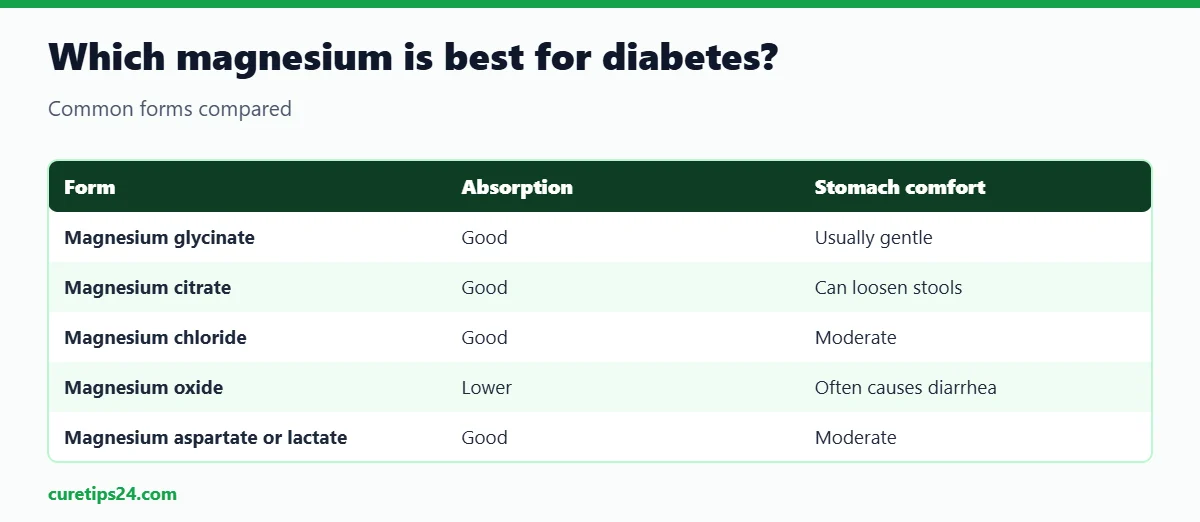
Supplement labels list elemental magnesium, the amount of actual magnesium in each dose, not the weight of the whole compound. The NIH says forms that dissolve well in liquid are absorbed more completely, and that aspartate, citrate, lactate and chloride appear more bioavailable than oxide and sulfate, although the comparison studies are small.
| Form | Absorption | Stomach comfort | Notes |
|---|---|---|---|
| Magnesium glycinate | Good | Usually gentle | Popular for people who get loose stools with other forms |
| Magnesium citrate | Good | Can loosen stools | Widely available and inexpensive |
| Magnesium chloride | Good | Moderate | Used in a trial in people with low magnesium |
| Magnesium oxide | Lower | Often causes diarrhea | High elemental content per tablet, used in some trials |
| Magnesium aspartate or lactate | Good | Moderate | Less common in stores |
Magnesium glycinate for diabetes
Glycinate (also sold as bisglycinate) is magnesium bound to the amino acid glycine. It is a common choice because it tends to be gentle on the stomach. There are few trials using glycinate specifically in diabetes, so the reason to pick it is comfort and absorption, not proof that it lowers blood sugar more than other forms.
Magnesium citrate and diabetes
Citrate is well absorbed and inexpensive. Its main downside is a laxative effect at higher doses, which some people find useful and others find annoying.
Magnesium oxide and diabetes
Oxide packs a lot of magnesium into a small tablet, but less of it is absorbed and it is one of the forms most often linked to diarrhea. It was still used successfully in at least one trial in people with diabetes, so it is not useless, just less comfortable for many people.
Check third-party tested magnesium glycinate on Amazon
How much magnesium is safe?
The recommended intake for adults is 400 to 420 mg a day for men and 310 to 320 mg a day for women, from all sources. The upper limit for supplemental magnesium is 350 mg a day for adults; food magnesium does not count toward that limit because healthy kidneys clear the extra.
- Start low, for example 100 to 200 mg of elemental magnesium a day, and take it with food.
- Stay at or below 350 mg a day from supplements unless your doctor advises more.
- Choose a product with third-party testing (such as a USP or NSF mark) so the label matches what is inside.
- Ask for a blood magnesium test if you are unsure whether you are low.

Who should be careful with magnesium for diabetes
Kidney disease
Diabetes is a leading cause of kidney disease, and damaged kidneys cannot clear extra magnesium well. The NIH warns that the risk of magnesium toxicity rises with impaired kidney function. Do not take magnesium supplements if you have kidney disease unless your kidney doctor recommends them.
Medicines that interact with magnesium
- Osteoporosis medicines (bisphosphonates): take them at least 2 hours apart from magnesium.
- Some antibiotics (tetracyclines and quinolones): take the antibiotic at least 2 hours before or 4 to 6 hours after magnesium.
- Water pills (diuretics): some increase magnesium loss and others reduce it.
- Long-term acid reducers (PPIs): can lower magnesium levels over time.
Always tell your pharmacist about supplements, because the list of interactions is longer than this.
Magnesium for diabetes: food first
Most people can raise their magnesium intake with food, which also brings fibre that helps blood sugar. Good sources include pumpkin seeds, almonds, cashews, spinach, black beans, edamame, whole grains, oats and dark chocolate. See our guides to the best foods for weight loss and whether Quaker oats are good for weight loss for simple ways to build these into meals.
Signs of low magnesium
Mild deficiency often has no clear symptoms. When it does, early signs can include loss of appetite, nausea, fatigue and weakness, and more severe deficiency can cause muscle cramps, tingling and an irregular heartbeat. These symptoms have many causes, so a blood test is more useful than guessing. Our guide on why it helps to understand how the human body works explains how to prepare questions for your doctor.
Frequently asked questions
Can diabetics take magnesium glycinate?
Many people with diabetes can, but check with your doctor first, especially if you have kidney disease or take several medicines. Glycinate is a gentle, well-absorbed form, not a treatment for diabetes.
Does magnesium lower blood sugar?
In trials, magnesium supplements modestly lowered fasting blood sugar, mostly in people who were low in magnesium. It does not replace diabetes medicine.
Is magnesium citrate or glycinate better for diabetes?
Both are well absorbed. Citrate is cheaper but more likely to loosen stools; glycinate is usually gentler. Neither has been proven better for blood sugar.
Is magnesium for diabetes safe with metformin?
Talk to your doctor or pharmacist. Some people on long-term diabetes and acid-reducing medicines run low in magnesium, and a blood test can show whether a supplement is needed.
The bottom line
The best magnesium for diabetes is the one you actually need, at a safe dose, in a form you tolerate. Get your level checked, eat more magnesium-rich foods, and if a supplement is advised, a modest dose of glycinate or citrate is a reasonable choice. Keep taking your prescribed diabetes treatment, and never use a supplement in its place.
Last checked: November 2026. Supplement formulas and labels change, so check the elemental magnesium per serving on the current label.