As an Amazon Associate, CureTips24 earns from qualifying purchases. We did not test these towels in person; this guide is based on maker specifications, published reviews and hair care guidance. It is general information, not medical advice.
If you have curly or wavy hair, the way you dry it matters almost as much as the products you use. A regular bath towel has rough loops that grab wet strands, and rubbing your hair with one breaks up curl clumps and causes frizz. A microfiber hair towel is smoother, absorbs water quickly and lets you squeeze, scrunch and plop your curls without roughing them up.
This guide compares the best microfiber hair towels for curly hair, explains which size and style to choose, and walks you through the plopping method step by step.
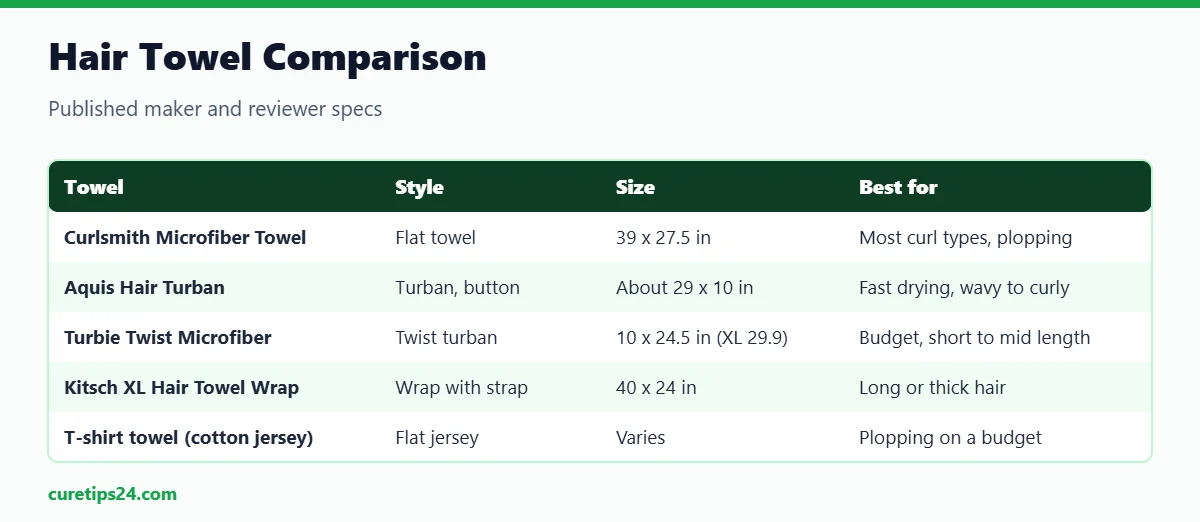
Table of Contents
Quick Picks
- Best overall: Curlsmith Microfiber Towel
- Best turban for fast drying: Aquis Hair Turban
- Best budget: Turbie Twist Microfiber
- Best for long or thick hair: Kitsch XL Hair Towel Wrap
- Best for plopping on a budget: cotton T-shirt towel
Why Curly Hair Needs a Gentler Towel
Wet hair is more delicate than dry hair. Dermatologist Timothy Schmidt, MD, of University of Utah Health explains that water weakens the hair’s protein structure, making it more fragile and prone to breakage. His advice is to gently blot, not rub, your hair with a microfiber towel or T-shirt, because these materials are softer than a regular towel and help reduce friction.
For curls, there is a second benefit: less friction keeps curl clumps together, so your curls dry more defined and less frizzy. Pair your towel with a good curly hair care routine for the best results.
1. Curlsmith Microfiber Towel
Best overall. Curl Centric names the Curlsmith towel its best overall pick, largely because of its size: at 39 by 27.5 inches, it is the biggest flat towel in its comparison, and it is made from an 88% polyester, 12% polyamide blend. A large flat towel lets you lay all your hair across it and fold it over without twisting your curls tightly, which makes it ideal for plopping medium to long curls.
Pros: very large, flat shape suits plopping, made by a curl-focused brand.
Cons: no button or strap; pricier than basic towels.
Check the Curlsmith Microfiber Towel on Amazon
2. Aquis Hair Turban
Best turban for fast drying. Aquis is one of the original hair towel brands. Its towels use Aquitex, a microfiber blend of about 80% polyester and 20% nylon, designed to absorb water quickly without rubbing. Its turbans have a button closure that keeps the wrap in place while you get ready, and reviewers recommend them for wavy to curly hair and fine hair. Aquis also makes larger flat towels for longer hair. Consumer Reports included Aquis alongside DevaCurl and Turbie Twist when its staff tried microfiber hair towels on different hair types.
Pros: quick drying, secure button, lightweight, well known.
Cons: turban size may be short for very long or thick hair; premium price.
Check the Aquis Hair Turban on Amazon
3. Turbie Twist Microfiber
Best budget. Turbie Twist is the classic twist-and-loop hair towel, and it is often named a best budget pick because it usually comes in multipacks. Curl Centric lists the standard size at 10 by 24.5 inches (XL at about 10 by 29.9 inches) and the microfiber version at 87% polyester, 13% polyamide. It suits short to shoulder-length hair; for long, thick curls it may be too small. Check you are buying the microfiber version, as a cotton version is also sold.
Pros: very affordable, multipacks, easy loop closure.
Cons: small for long hair; twisting can stretch curls if done too tightly.
Check the Turbie Twist on Amazon
4. Kitsch XL Hair Towel Wrap
Best for long or thick hair. Kitsch’s XL wrap measures about 40 by 24 inches and has an elastic strap to hold it in place, so it gives long or thick curls plenty of room. It is a good choice if turbans feel too small but you still want something hands-free. Kitsch also sells smaller microfiber wraps and satin-lined versions.
Pros: extra large, secure strap, stylish colors.
Cons: heavier when wet; may be too big for short hair.
Check the Kitsch XL Hair Towel Wrap on Amazon
5. Cotton T-Shirt Towel
Best for plopping on a budget. Many curly-haired people swear by plopping in a soft cotton T-shirt. Cotton jersey is a flat knit without loops, so it is gentle on curls. It absorbs less water than microfiber, but it is very gentle and great for plopping. You can use an old soft T-shirt, or buy a purpose-made T-shirt hair towel that is larger and shaped for wrapping.
Pros: very gentle, cheap or free, great for plopping.
Cons: less absorbent; can be bulky.
Check T-shirt hair towels on Amazon
How to Choose a Hair Towel for Curly Hair
Size matters most
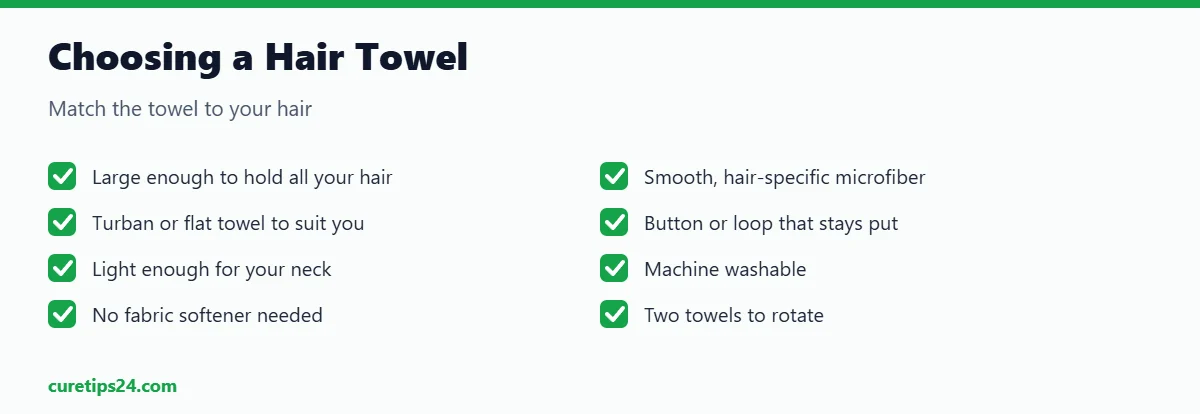
As Curl Centric points out, size matters more than brand. A standard twist turban is about 10 by 24.5 inches, while a large flat towel can be close to 40 inches long. If you cannot lay your hair across the towel with room to fold it over, the towel is too small, and you may end up twisting your curls tightly.
Flat towel vs turban
Flat towels are best for plopping and scrunching, because you can lay your curls down without twisting. Turbans are hands-free and quick to put on, and they work well for shorter hair or for a few minutes while you get ready.
Closure
Buttons, loops and elastic straps keep a turban in place. Flat towels are tied or twisted at the nape.
Weight
Thick, plush towels hold more water but can feel heavy on your neck. Thin microfiber is lighter and still absorbs well.
How to Plop Curly Hair

- Apply your products (leave-in conditioner, cream or gel) to soaking wet hair.
- Lay a large microfiber towel or T-shirt flat on a counter, bed or chair.
- Lean forward and lower your curls onto the center of the towel so they pile on top of each other.
- Fold the towel over your head and twist the sides together at the nape of your neck, then tie them on top or at the front.
- Leave it for 10 to 20 minutes, or longer if your curls like it.
- Unwrap gently, then air dry or use a diffuser on low heat. Our guide to the best hair dryer for curly hair covers diffusers.
Other Gentle Drying Methods
- Scrunching: cup sections of curls in the towel and squeeze upward toward the scalp to remove water and encourage curl shape.
- Squeezing: wrap a section in the towel and press gently. Never wring or twist hard.
- Blotting: pat the towel against your hair instead of rubbing.
- Micro-plopping: scrunch small sections with a microfiber towel to remove water before styling.
Caring for Your Microfiber Towel
- Wash it regularly in warm or cool water with a gentle detergent.
- Skip fabric softener, which can coat the fibers and reduce absorbency.
- Wash it separately from lint-heavy items like cotton bath towels, which can leave fluff in the fibers.
- Air dry or tumble dry on low, following the care label.
- Keep two towels so you always have a clean one ready.
Choosing a Towel by Curl Type
Wavy hair (2A to 2C)
Waves are easily weighed down and stretched. A lightweight microfiber turban or a small flat towel used for scrunching works well. Plop for a shorter time so waves are not flattened.
Curly hair (3A to 3C)
A large flat microfiber towel or T-shirt is ideal for plopping and keeps curl clumps together. Scrunch upward toward the scalp to encourage curl shape.
Coily hair (4A to 4C)
Coily hair is often the most fragile and prone to dryness. Use a gentle T-shirt or soft microfiber towel, squeeze rather than rub, and leave hair slightly damp before applying moisturizing products. Work in sections to avoid tangles.
Common Mistakes When Drying Curly Hair
- Rubbing hair with any towel: even microfiber causes frizz if you rub. Squeeze, scrunch or blot instead.
- Twisting too tightly: a tight twist turban can stretch curls and pull at the hairline. Keep it snug but comfortable.
- Using a towel that is too small: cramming long curls into a small turban squashes them. Size up.
- Removing too much water before styling: many curly routines work best when products go on soaking wet hair.
- Brushing curls dry: brushing dry curls breaks up clumps and causes frizz. Detangle while wet with conditioner instead.
- Washing towels with softener: softener coats microfiber and makes it less absorbent.
For more frizz-fighting tips, see our guide to hair care for frizzy hair.
Detangling Before You Dry
The best time to detangle curly hair is in the shower, when it is wet and coated in conditioner. Use your fingers or a wide-tooth comb, working from the ends up to the roots. Many curly-haired people use a Denman brush for curly hair to define curls while the hair is still wet. Detangling gently before drying reduces breakage; our article on preventing hair breakage has more tips.
Protect Your Curls Overnight
Once your curls are dry, protect them while you sleep. Friction from a cotton pillowcase can cause frizz and flatten curls. Many people use a satin bonnet or a silk pillowcase, or both. See our guides to the best satin bonnet for curly hair and the best silk pillowcase for hair and skin. In the morning, refresh curls with a light mist of water or leave-in and scrunch with your microfiber towel.
Can You Use a Microfiber Towel on Your Body?
Hair towels are designed for hair, so they are usually smaller than bath towels. You can use them on your body, but a microfiber hair towel works best when you keep it just for hair. That keeps it free from body lotions and oils that can make microfiber less absorbent over time.
Frequently Asked Questions
Is microfiber really better than a cotton towel for curls?
For most curly-haired people, yes. Microfiber is smoother and absorbs water quickly, so you can remove water with less rubbing. The technique matters as much as the towel: always squeeze or blot, never rub.
Microfiber or T-shirt for curly hair?
Both work. Microfiber absorbs more water and dries hair faster; a cotton T-shirt is extremely gentle but less absorbent. Try both and see which your curls prefer.
How long should I plop my hair?
Most people plop for 10 to 20 minutes. Some leave it longer. Avoid sleeping in a wet towel, as long periods of damp hair against the scalp are not ideal.
Can a microfiber towel make hair frizzy?
It can if you rub with it, or if the towel is rough or too small. Use a smooth, hair-specific towel and squeeze or plop instead.
Are microfiber towels good for straight hair too?
Yes. They are gentle on any hair type and help reduce drying time, which means less heat styling.
How often should I replace my hair towel?
A good microfiber towel can last a long time with proper care. Replace it when it feels rough, sheds fibers, smells after washing, or no longer absorbs water well.
Can I use a microfiber towel with a diffuser?
Yes. Plop or scrunch with the towel first to remove extra water, then diffuse on low heat. Less water in your hair means less time under the dryer and less heat on your curls.
Are satin-lined towels better?
Satin-lined wraps add a smooth layer against the hair while the outer microfiber absorbs water. Some people with very frizz-prone hair prefer them, but a plain smooth microfiber towel works well for most curls.
Can kids use microfiber hair towels?
Yes. Small, lightweight turbans are popular for children with long or curly hair because they are quick to put on and gentle on tangles.
Final Verdict
The Curlsmith Microfiber Towel is our top pick for curly hair because its large, flat shape is perfect for plopping. Choose the Aquis Hair Turban for quick, hands-free drying, the Turbie Twist for a budget multipack, the Kitsch XL Wrap for long or thick curls, and a cotton T-shirt towel for gentle plopping on a budget. Whatever you choose, squeeze and blot instead of rubbing.
Browse microfiber hair towels on Amazon