
Quick answer: for the best eye care in Minneapolis, start with a comprehensive eye exam from an optometrist or ophthalmologist, then see a specialist clinic if your symptoms need it. For hard-to-treat dry eye, Twin Cities options include the M Health Fairview Eye Clinic (University of Minnesota), Phillips Eye Institute at Abbott Northwestern Hospital, Chu Vision Institute in Bloomington and the Dry Eye & Blepharitis Center at Northwest Eye. For severe or complex cases, Mayo Clinic’s dry eye clinic in Rochester offers advanced testing and treatment. If you suddenly see a shower of new floaters, flashes or a dark curtain, get same-day care.
CureTips24 is reader-supported. We may earn a commission when you buy through links on this page, at no extra cost to you. Learn more.
How we put this together: we have not visited these clinics and no clinic paid to be listed. We used each clinic’s own website and published health information from the National Eye Institute and university eye centers, and we link each source. This article is general information, not medical advice. For any eye symptom, talk to an eye doctor.
Table of Contents
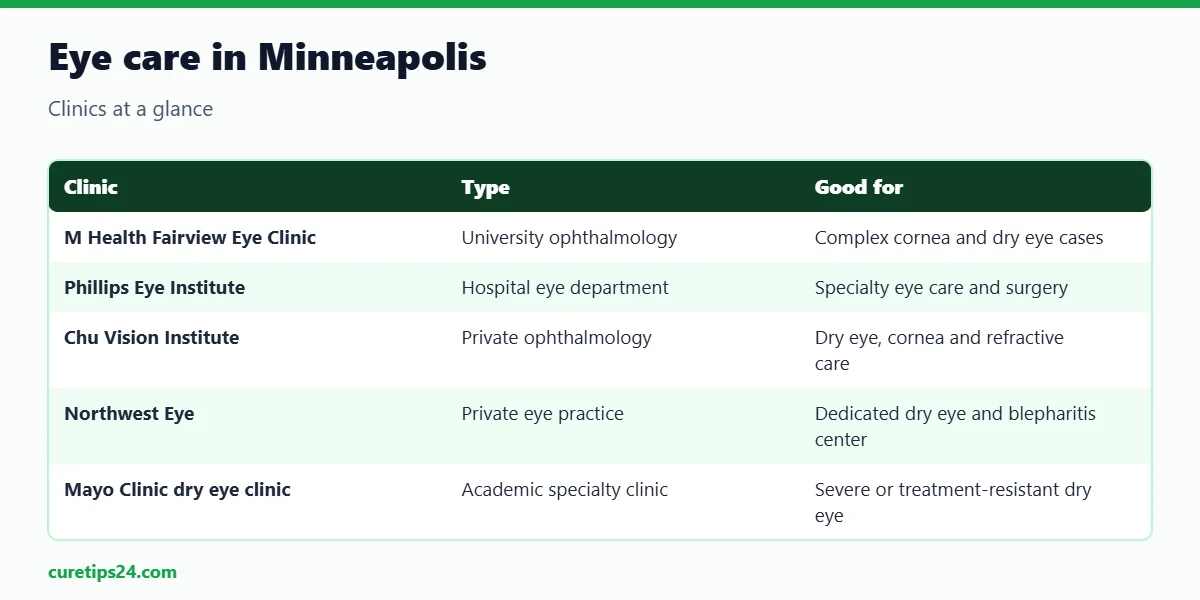
Eye care in Minneapolis at a glance
| Clinic | Type | Area | Good for |
|---|---|---|---|
| M Health Fairview Eye Clinic | University ophthalmology | Minneapolis (U of M) | Complex cornea and dry eye cases |
| Phillips Eye Institute | Hospital eye department | Minneapolis | Specialty eye care and surgery |
| Chu Vision Institute | Private ophthalmology | Bloomington | Dry eye, cornea and refractive care |
| Northwest Eye | Private eye practice | Twin Cities | Dedicated dry eye and blepharitis center |
| Mayo Clinic dry eye clinic | Academic specialty clinic | Rochester | Severe or treatment-resistant dry eye |
This is not a ranking. Each clinic suits different needs, and the best choice for you depends on your symptoms, your insurance and how far you can travel.
Do you need an optometrist or an ophthalmologist?
An optometrist (OD) handles eye exams, glasses, contact lenses and many common problems, including mild to moderate dry eye. An ophthalmologist (MD) is a medical doctor who can also perform surgery and treat complex eye disease. A cornea specialist is an ophthalmologist with extra training in the front surface of the eye, which is where dry eye causes damage. Most people start with an optometrist and get referred on if needed.
1. M Health Fairview Eye Clinic (University of Minnesota)
The M Health Fairview Eye Clinic at 516 Delaware Street SE in Minneapolis is the clinical home of University of Minnesota eye specialists. Its cornea and external disease specialists see patients with dry eye and other ocular surface problems. University physician profiles list treatments such as punctal plugs and amniotic membrane treatments for the eye surface. M Health Fairview also runs optometry clinics for routine exams and contact lens fitting.
- Best for: complex dry eye, corneal disease and second opinions.
- Keep in mind: academic clinics can have longer waits for new patient appointments.
2. Phillips Eye Institute (Allina Health)
Phillips Eye Institute is a department of Abbott Northwestern Hospital, part of Allina Health, and is dedicated to treating eye diseases and disorders. Allina says its credentialed ophthalmologists offer an extensive range of specialty services. It is a long-standing name in Minneapolis eye care and a common referral point for surgery.
- Best for: specialty ophthalmology and eye surgery within the Allina network.
- Keep in mind: check which providers and services are offered at each Allina location.
3. Chu Vision Institute (Bloomington)
Chu Vision Institute in Bloomington offers dry eye treatment led by Dr. Ralph Chu, a board-certified ophthalmologist and fellowship-trained corneal specialist. The clinic says many patients improve after one session of in-office treatment, with best results usually from a series tailored by the doctor.
- Best for: dry eye and cornea care from a private specialist practice south of Minneapolis.
- Keep in mind: ask which treatments your insurance covers, as some in-office dry eye procedures are self-pay.
4. Northwest Eye Dry Eye & Blepharitis Center
Northwest Eye runs a dedicated Dry Eye & Blepharitis Center that starts with a thorough evaluation and a specific diagnosis before building a treatment plan. Its diagnostic tests include LipiView, which images the tear film and measures the oily (lipid) layer of your tears.
- Best for: people whose dry eye is linked to eyelid inflammation (blepharitis) or oil gland problems.
- Keep in mind: confirm the nearest location and whether a referral is needed.
5. Mayo Clinic dry eye clinic (Rochester)
If your dry eye has not improved with standard treatment, Mayo Clinic’s dry eye clinic in Rochester, Minnesota, is worth the drive. Mayo says the clinic begins with a complete dry eye evaluation, including imaging of the eye surface and meibomian glands, and offers in-office treatments such as lid cleaning and meibomian gland treatments. For severe symptoms that do not respond to other treatments, it can offer autologous serum drops, made from the patient’s own blood.
- Best for: severe, painful or treatment-resistant dry eye.
- Keep in mind: you may need a referral, and Rochester is a separate trip from the Twin Cities.
What a good dry eye evaluation includes
According to the National Eye Institute, dry eye happens when your tears do not keep your eyes wet enough, because your eyes do not make enough tears or the tears dry up too fast. Common symptoms include burning, a scratchy feeling, blurry vision and red eyes. To diagnose it, your doctor may check:
- How many tears your eyes make.
- How quickly your tears dry up (tear break-up time).
- The structure of your eyelids and oil glands.
- The health of your cornea, the clear front surface of the eye.
- Medicines and health conditions that can cause dryness.
Treatment depends on the cause. The NEI lists eye drops and lifestyle changes as the main options, with procedures such as punctal plugs and, in some cases, surgery for loose lower eyelids. Untreated severe dry eye can damage the cornea, so see a doctor if symptoms last.

Eye floaters: when to get urgent care in Minneapolis
Most floaters are harmless specks that drift across your vision and become more common with age. But a sudden change can be an emergency. Duke Eye Center warns that a sudden increase in floaters may signal a retinal tear or detachment, which can threaten your vision, and advises getting to an ophthalmologist right away.
Get same-day eye care if you notice:
- A sudden shower of new floaters, or one large new floater.
- Flashes of light, especially at the edge of your vision.
- A shadow or curtain moving across part of your vision.
- Any sudden loss or blurring of vision.
If your regular eye doctor cannot see you the same day, go to a hospital emergency department or ask for an urgent retina appointment. Long-standing floaters that have not changed usually do not need treatment, but mention them at your next eye exam.

Simple ways to ease dry eyes at home
While you wait for an appointment, these habits may help mild dryness. They do not replace an exam.
- Use preservative-free artificial tears, which are gentler for frequent use.
- Take screen breaks and blink fully; long screen sessions reduce blinking.
- Run a humidifier in dry winter months; Minnesota winters and indoor heating are hard on eyes. See our best humidifier for dry skin guide.
- Try a warm compress on closed eyelids if your eye doctor recommends it.
- Get enough sleep; see does lack of sleep affect your skin for how sleep affects the face and eyes.
Check preservative-free artificial tears on Amazon
Check heated eye masks on Amazon
Ask your eye doctor before using any product, especially if you wear contact lenses, have had eye surgery or use prescription drops. For puffiness and dark circles rather than dryness, see our eye cream for dark circles guide.
How to choose the right eye clinic
- Check your insurance network before booking; eye care can be billed under medical or vision plans.
- Match the clinic to your problem: routine exams with an optometrist, complex disease with an ophthalmologist or cornea specialist.
- Ask what testing they offer for dry eye, such as tear film imaging or gland imaging.
- Ask about costs for in-office procedures that insurance may not cover.
- Consider location and wait times, especially if you need several follow-up visits.
Frequently asked questions
What is the best eye care in Minneapolis for dry eye?
It depends on how severe your dry eye is. Start with an optometrist or ophthalmologist for an exam. For complex cases, cornea specialists at the M Health Fairview Eye Clinic, dedicated dry eye centers such as Northwest Eye, or Mayo Clinic’s dry eye clinic in Rochester offer more advanced testing and treatment.
Do I need a referral to see an eye specialist in Minneapolis?
Some clinics and insurance plans require one, especially for specialist or academic clinics. Call the clinic and your insurer before booking.
Are eye floaters an emergency?
Usually not, but a sudden increase in floaters, new flashes of light or a curtain over your vision can mean a retinal tear and need same-day care.
Is dry eye worse in Minnesota winters?
Many people notice more dryness in winter, when cold outdoor air and indoor heating lower humidity. A humidifier and regular breaks from screens can help.
The bottom line
The best eye care in Minneapolis starts with a good general eye exam, then the right specialist for your problem. University, hospital and private clinics across the Twin Cities treat dry eye, and Mayo Clinic in Rochester handles the hardest cases. Do not wait with sudden floaters or flashes: get same-day care. For anything else, check your insurance, ask what testing the clinic offers and book early, as specialist appointments can fill up.
Last checked: November 2026. Clinic locations, services, providers and insurance networks change, so confirm details directly with the clinic before you book.

1 thought on “Best Eye Care in Minneapolis”