Table of Contents
Quick Summary / At A Glance
- Myrrh is a fragrant resin from Commiphora trees, used for centuries in incense, perfume and traditional preparations, and now trending as a skincare oil.
- Modern clinical evidence for myrrh oil on skin is thin: tradition and laboratory interest are not the same as proven benefits in people.
- There is no reliable proof that myrrh oil cures skin conditions, heals wounds, or reverses ageing, and it should never be sold that way.
- As a concentrated fragrance material it can irritate or sensitise skin, especially undiluted, on damaged skin, or with long, frequent use.
- People who are pregnant, breastfeeding, or treating a real skin problem should avoid experimenting and ask a healthcare professional instead.
Few ingredients arrive with better storytelling than myrrh. It appears in ancient texts, religious ceremonies and traditional medicine chests, and searches for it have spiked dramatically as skincare shoppers rediscover old resins.
With that spike has come a familiar pattern: firm, glowing claims running far ahead of the evidence. Anti-ageing, healing and purifying promises now attach themselves to small amber bottles across social media.
This article separates the two honestly. Myrrh’s history is genuinely rich and interesting; what modern research can actually say about putting its oil on your skin is much more modest.
What Myrrh Actually Is
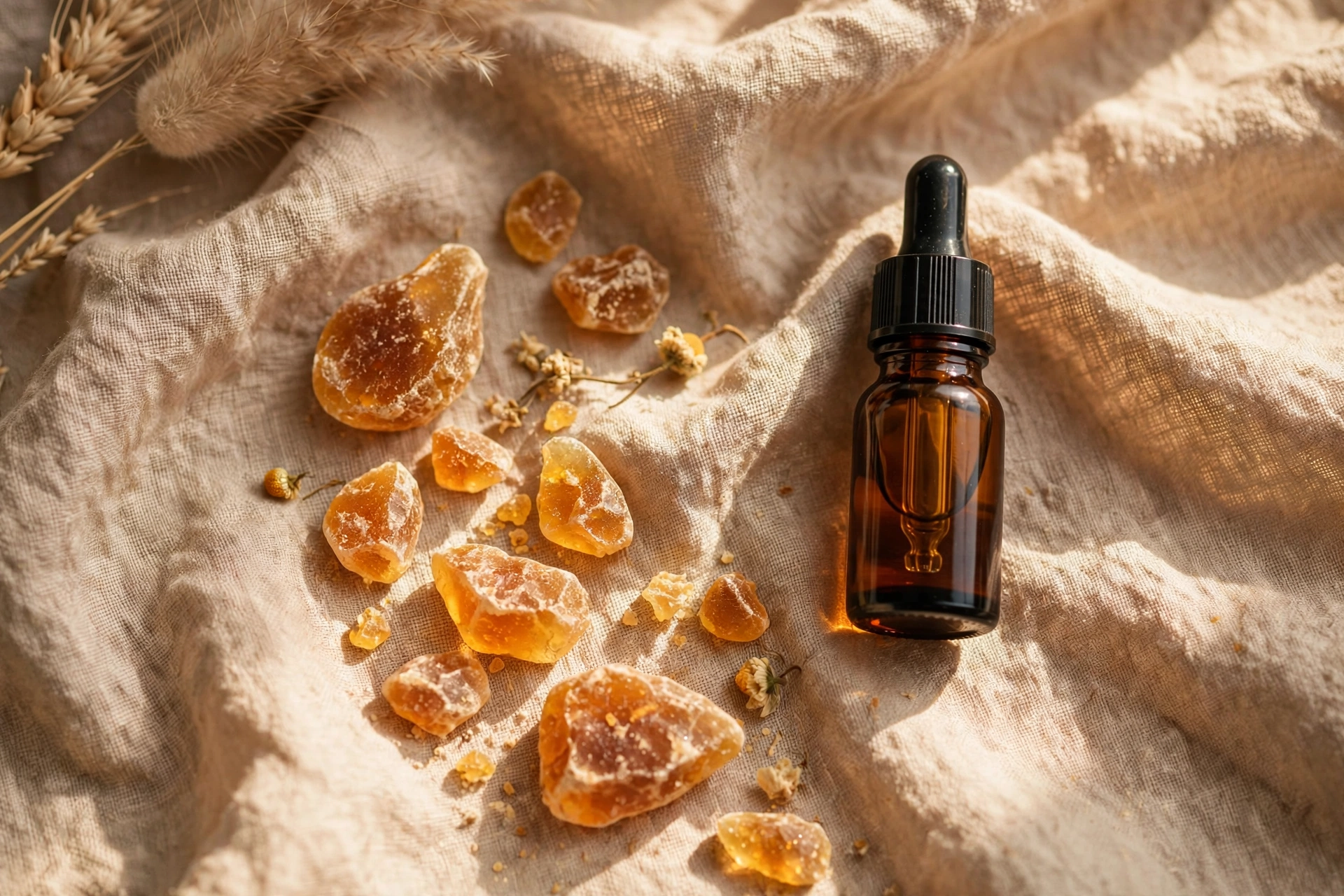
Myrrh is a resin that oozes naturally from the bark of Commiphora trees, which grow in dry regions including parts of north-east Africa and the Arabian Peninsula. The resin hardens into amber-coloured tears that can be ground, burned as incense, or processed into extracts.
Myrrh essential oil is usually made by steam-distilling that resin. The result is a concentrated, strongly scented oil whose warm, balsamic smell explains its long career in perfumery and ritual use.
Concentrated is the key word. An essential oil is not a gentle plant water; it contains a dense mix of fragrant compounds, which is why essential oils in general are used diluted, in small amounts, or simply as scent.
Products vary widely, too. Some bottles are pure essential oil, some are resin extracts in a carrier, and some finished creams contain only a trace for fragrance, so the label matters more than the legend on the front.
A Long Traditional History — and Its Limits
Myrrh has been traded and treasured for thousands of years. It was used in ancient Egyptian preparations, in traditional practices across several cultures, and in older European herbal traditions for the mouth, skin and general comfort.
Traditional use deserves respect as history, and it often gives researchers ideas about what to study. Many useful modern ingredients did begin as traditional remedies that later survived proper testing.
But tradition alone cannot tell us dose, safety for daily facial use, or whether an effect people believed in actually holds up. Practices also changed constantly, and old preparations were usually short-term and local, not twice-daily facial routines.
The honest summary is that myrrh’s past proves people valued it. It does not prove that a modern essential oil will improve wrinkles, calm diagnosed skin disease, or speed up healing when rubbed on at home.
What Modern Evidence Can and Cannot Say
Most modern interest in myrrh comes from laboratory work, where extracts are studied for properties such as effects on microbes or inflammation in controlled settings. Laboratory findings are a starting point, not a result in human skin.
Well-designed human trials of myrrh oil applied to skin for cosmetic goals are scarce. That scarcity is the central fact of this fact-check, and any article or advert that skips it is leaving out the part that matters most.
What can be said fairly is modest: myrrh has a distinctive fragrance, a long record in perfumery, and extracts that researchers continue to find interesting. Skin may also simply enjoy the carrier oil a diluted product is blended into, which is a benefit of the base, not the resin.
Claims beyond that — curing, firming, resurfacing, or healing — go past the evidence. If you enjoy structured, evidence-led routines such as the approach in our guide to skin cycling, myrrh oil belongs firmly in the optional fragrance category, not an active treatment slot.
| Claim you may see | Honest position |
|---|---|
| Ancient wisdom proves it works on skin | Tradition shows historical use, not tested results; modern human evidence is thin |
| Heals wounds and damaged skin | Not proven, and oils do not belong on open or infected skin without medical advice |
| Reverses ageing and firms skin | No reliable proof; fragrance and a rich carrier oil can feel pleasant without changing skin structure |
| Natural, so it is automatically gentle | No; concentrated fragrance materials can irritate or sensitise skin |
| Safe for everyone, including in pregnancy | Caution is advised; safety data is limited and professional advice should come first |
An ingredient can be historically fascinating and cosmetically pleasant while still failing every medical claim made for it. Holding both ideas at once is the whole skill of reading skincare trends well.
The Risks: Fragrance, Sensitisation and Dilution
The most realistic risk from myrrh oil is the one shared by many essential oils: irritation and allergic sensitisation. Sensitisation can build quietly over months of exposure and then appear suddenly as itching, redness or a rash where the product is applied.
Undiluted essential oil on facial skin raises that risk considerably, as does using old, oxidised oils. Warmth, light and air degrade essential oils over time, and degraded fragrance materials are more likely to trouble skin.
Never apply myrrh oil to broken, infected, eczematous or freshly treated skin, and keep it out of eyes and away from children. A scent that feels grounding in a diffuser is a different exposure from a concentrated oil left on a face all night.
Stop using any fragranced oil that brings persistent burning, swelling, blistering or spreading rash, and seek medical advice if symptoms are strong or do not settle. Skin that is reacting needs less input, not a stronger natural remedy.
Pregnancy and Other Reasons to Ask First
Essential oils are commonly advised with caution in pregnancy, and myrrh in particular carries traditional warnings alongside limited modern safety data. The responsible advice is simple: do not experiment with it on skin while pregnant or breastfeeding without professional guidance.
The same applies if you take regular medicines or manage a long-term condition. Concentrated plant extracts are biologically active materials, and assuming they cannot interact with anything is optimism, not evidence.
Anyone whose real goal is treating a skin problem — a stubborn rash, a wound that will not close, changing moles, persistent acne — should start with a clinician, not a resin. Delaying proper assessment is the most expensive outcome a viral ingredient can cause.
For general guidance on building a routine from proven steps first, our explainer on how to use a face serum shows where optional, pleasurable extras honestly sit: last, lightly held, and easy to drop.
If You Still Want to Enjoy Myrrh, Do It as Fragrance
The safest way to enjoy myrrh is the way history mostly used it: as scent. A trace in a well-made, finished cosmetic product, used as directed, is a very different proposition from applying drops of pure oil to your face.
If you buy a blended facial product, patch test first, introduce it alone, and keep the rest of your routine boring while you watch for delayed reactions over a couple of weeks. Sensitisation is slow, so patience is part of the test.
Store oils cool, dark and tightly closed, note when you opened them, and discard them when the smell turns sharp or stale. With fragrance materials, freshness is a safety feature, not a nicety.
Judge the experience honestly afterwards. Pleasant scent, a comfortable texture and a moment of ritual are legitimate pleasures; they simply should be bought at fragrance prices and with fragrance expectations.
The Bottom Line on Myrrh Oil for Skin
Myrrh is an ancient, storied resin whose modern skincare fame has outrun its evidence. What is actually known would fit on an index card: it smells wonderful, researchers find its extracts interesting, and human skin evidence remains thin.
Enjoy it, if you like, as fragrance inside a sensible routine. Do not buy it as a cure, a healer or an anti-ageing treatment, do not apply it undiluted or to damaged skin, and ask a professional first in pregnancy or illness.
Your skin will get far more from gentle cleansing, steady moisturising, daily sun protection and prompt medical care for real problems than from any resin, however beautiful its story sounds.
This article is general information only and is not medical advice. Please consult a healthcare professional for personal advice.