Table of Contents
Quick Summary / At A Glance
- Pumpkin seed oil blended with saw palmetto is one of the fastest-rising hair searches — trend trackers put the combination near 15,000 monthly searches, up more than 300% year on year.
- One small 24-week trial found that pumpkin seed oil capsules modestly increased hair count in men with pattern hair loss compared with a placebo.
- Saw palmetto has a longer folk history for hair, but its clinical evidence is thinner and more mixed than its marketing suggests.
- Neither ingredient regrows hair reliably, and neither replaces diagnosis or proven treatments — think mild support at best, not a cure.
- Saw palmetto can interact with medicines and is not for pregnancy or breastfeeding; talk to a doctor or pharmacist before taking either as a supplement.
Hair-loss searches are getting more specific. Instead of broad “growth supplements,” people now search for named ingredients — and one of the fastest climbers is a blend: pumpkin seed oil with saw palmetto, marketed for fuller-looking hair.
The story behind the blend is simple. Both ingredients are linked, in folk use and in early research, to the hormone pathways involved in pattern hair loss. Natural, plant-based, no prescription — the appeal writes itself.
But “natural” is not the same as “proven,” and a 300% search spike is not the same as a strong evidence base. This article checks what each ingredient actually is, what the small studies found, and where the honest limits sit.
Why This Blend Is Suddenly Everywhere
Search-trend data puts “pumpkin seed oil with saw palmetto” at roughly 14,800 monthly searches, up about 311% year on year — one of the sharpest rises in the hair-loss ingredient table. The broader pattern is clear: shoppers have moved from generic growth supplements toward named, specific ingredients.
The blend usually appears in capsules, sometimes with added biotin or other botanicals, and occasionally in topical oils. Marketing tends to frame it as a gentle, natural alternative for people who want to act early on thinning — a group that is itself growing, as people now address hair loss in their twenties and thirties rather than waiting.
Early action is sensible. The question is whether this particular blend deserves a place in that plan, or whether the search spike is doing the selling.
What Pumpkin Seed Oil Is
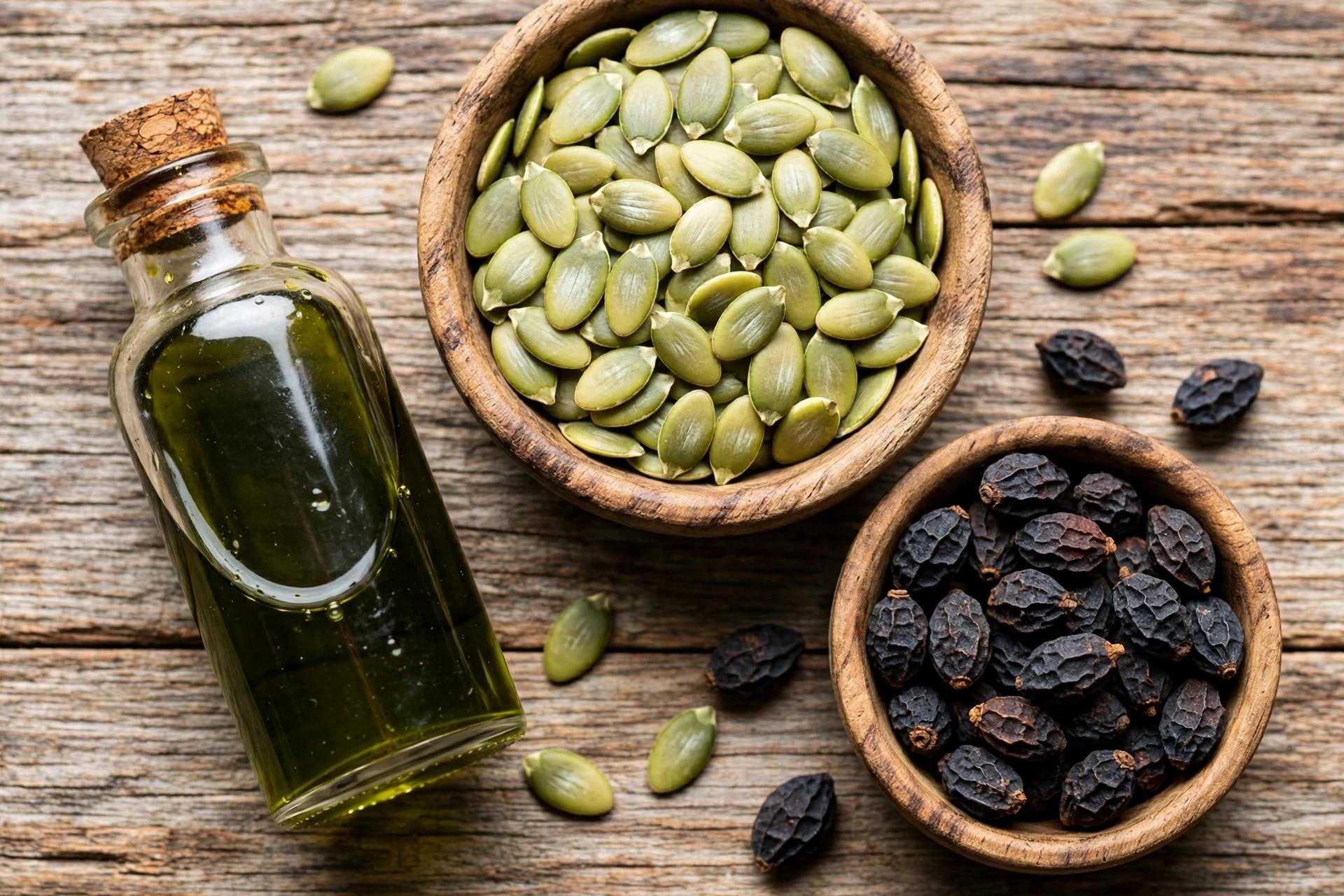
Pumpkin seed oil is pressed from the seeds of pumpkins, and the cold-pressed kind is a deep green, nutty-smelling oil rich in unsaturated fatty acids, vitamin E, zinc and plant sterols including beta-sitosterol. It is a food oil first — the hair claims came later.
The proposed link to hair is indirect. Some laboratory work suggests that compounds in pumpkin seed oil may mildly interfere with the conversion of testosterone to DHT, the hormone most implicated in pattern hair loss. “May” and “in a lab dish” are doing a lot of work in that sentence.
It is worth noting what pumpkin seed oil is not: it is not a DHT blocker in the pharmaceutical sense, and eating pumpkin seeds or rubbing the oil on your scalp has not been shown to change hair outcomes. The evidence that exists is about capsules, taken daily, in one small trial.
What Saw Palmetto Is
Saw palmetto is a small palm native to the southeastern United States, and its dark berries have a long folk history for urinary and hair complaints. Like pumpkin seed oil, it is proposed to mildly affect DHT-related pathways — which is why the two are so often sold together.
The clinical picture is genuinely mixed. A few small studies have reported modest benefits for hair, but they tend to be short, small, and sometimes funded by product makers. Larger, better-designed trials are missing, and dermatology guidelines do not list saw palmetto among proven hair-loss treatments.
Its longer history cuts both ways. Decades of traditional use mean it is not some overnight invention — but they have not produced the kind of evidence that would convince a sceptical clinician either.
What the Research Actually Found
The most-cited study is a small randomised trial published in 2014, in which men with pattern hair loss took 400 mg of pumpkin seed oil daily or a placebo for 24 weeks. The pumpkin seed oil group showed a modest increase in hair count compared with placebo — a real, published result, and also a small, short, single study.
One small trial is a starting point, not a verdict. It does not tell us whether the effect lasts, whether it works for women, what the best dose is, or how the oil compares with proven options. Honest sellers cite it; careful readers notice its limits.
For saw palmetto, the evidence is weaker still — mostly small or uncontrolled studies with mixed results. When the two are combined in a single capsule, as the trending products do, there are no good trials of the combination itself. The blend’s popularity is running well ahead of its proof.
How People Use the Blend — and What to Expect
Most products are oral capsules taken daily for several months. Hair grows slowly — roughly a centimetre a month — so no honest product can promise visible change in weeks. Anyone selling a one-month transformation is selling hope, not hair science.
Topical pumpkin seed oil products also exist, but there is no meaningful evidence that rubbing the oil on the scalp reproduces the capsule trial’s results. If you enjoy scalp massage with a pleasant oil, that is a fine ritual — as rosemary oil users will attest — but do not confuse the ritual with the research.
A realistic expectation is mild support at best: possibly a small improvement in hair count over many months, possibly nothing measurable. If shedding is sudden, patchy, or severe, that is a job for a dermatologist and proper diagnosis — not a supplement. Our guide to choosing a hair growth shampoo makes the same point: cosmetics support, they do not treat.
Safety Notes You Should Not Skip
Natural does not mean risk-free. Saw palmetto can interact with blood thinners, hormonal medicines and some other drugs, and it may affect PSA test results — men due for prostate screening should tell their doctor they take it. It should not be used in pregnancy or while breastfeeding.
Pumpkin seed oil as a food oil is very safe, but concentrated capsules are a different matter for anyone on medication. A quick word with a doctor or pharmacist costs little and can prevent real problems.
Also be wary of the blend’s marketing halo. Products that bundle the two ingredients often add biotin, collagen or “proprietary blends” at unknown doses — each addition is another claim without evidence. Simpler labels are easier to judge honestly.
Pumpkin Seed Oil vs Saw Palmetto at a Glance
| Pumpkin seed oil | Saw palmetto | |
|---|---|---|
| Source | Pressed pumpkin seeds | Berries of a dwarf palm |
| Best evidence | One small 24-week capsule trial | Small, mixed, mostly weak studies |
| Usual form | Capsules (400 mg/day in the trial) | Capsules or liquid extract |
| Main caution | Check with a clinician if medicated | Drug interactions; avoid in pregnancy |
| Honest verdict | Modest, early, unconfirmed | Traditional, thin evidence |
Neither column contains a proven treatment. What the table really shows is how much of the blend’s reputation rests on one small study and a long folk history — against a search curve rising 300% a year.
The Honest Bottom Line
Pumpkin seed oil with saw palmetto is an interesting corner of the hair-loss world: one genuinely published small trial, one widely used traditional berry, and a search spike far larger than the evidence behind it. If you try it, do so with measured expectations, a clinician’s awareness, and at least six months of patience.
And if your hair loss is sudden, patchy, or distressing, skip the supplement aisle first and see a dermatologist. The most effective thing you can do for thinning hair is to find out what kind it is.
This article is general information only and is not medical advice. Please consult a healthcare professional for personal advice.