Table of Contents
Quick Summary / At A Glance
- Fungal acne is Malassezia yeast overgrowth in hair follicles, not true bacterial acne.
- Clues are very itchy, small uniform bumps with no blackheads or whiteheads.
- Ordinary acne creams target bacteria and clogged pores, so they do not address yeast.
- Antibiotics can make it worse by reducing bacteria that compete with yeast.
- A dermatologist diagnosis matters before treatment, as both conditions can occur together.
Breakouts on the face, chest, or back are frequently assumed to be standard acne, leading many people to rely on traditional spot creams and facial washes. However, when those conventional products fail to clear the skin or cause breakouts to worsen, an underlying condition called fungal acne may be responsible. Recognizing that not all breakouts stem from the same cause is critical for understanding why standard routines fail.
Known in medical literature as Malassezia folliculitis or Pityrosporum folliculitis, this condition is not actually true acne at all. Instead, it is an inflammatory reaction that occurs when yeast naturally present on the skin overgrows inside hair follicles. Because it closely mimics common acne, it is frequently misdiagnosed and incorrectly managed for extended periods.
Attempting to treat a fungal issue with typical anti-acne ingredients often yields frustrating results and can even aggravate skin irritation. Learning the distinct clues, triggers, and daily habits can help individuals recognize when to seek professional care.
Understanding Fungal Acne: Why It Is Not True Acne
Acne vulgaris, commonly known as traditional or bacterial acne, develops when pores become clogged with dead skin cells, excess sebum, and bacteria such as Cutibacterium acnes. In contrast, Malassezia folliculitis stems from an overgrowth of microscopic Malassezia yeast. While both conditions affect the hair follicles and oil glands, their biological drivers are entirely different.
Under normal circumstances, Malassezia yeast lives peacefully on healthy human skin as part of the normal cutaneous flora. Problems arise only when specific environmental or biological factors disrupt this balance, prompting the yeast to proliferate. This rapid proliferation triggers an inflammatory response along the lining of the hair follicles.
Because the core driver of fungal acne is yeast rather than bacteria, ordinary acne products do not address the root issue. Standard acne formulations target bacterial activity and pore clogging, leaving yeast overgrowth untouched. Consequently, applying typical acne treatments to a fungal breakout will fail to resolve the problem.
How Fungal Acne Mimics Common Acne
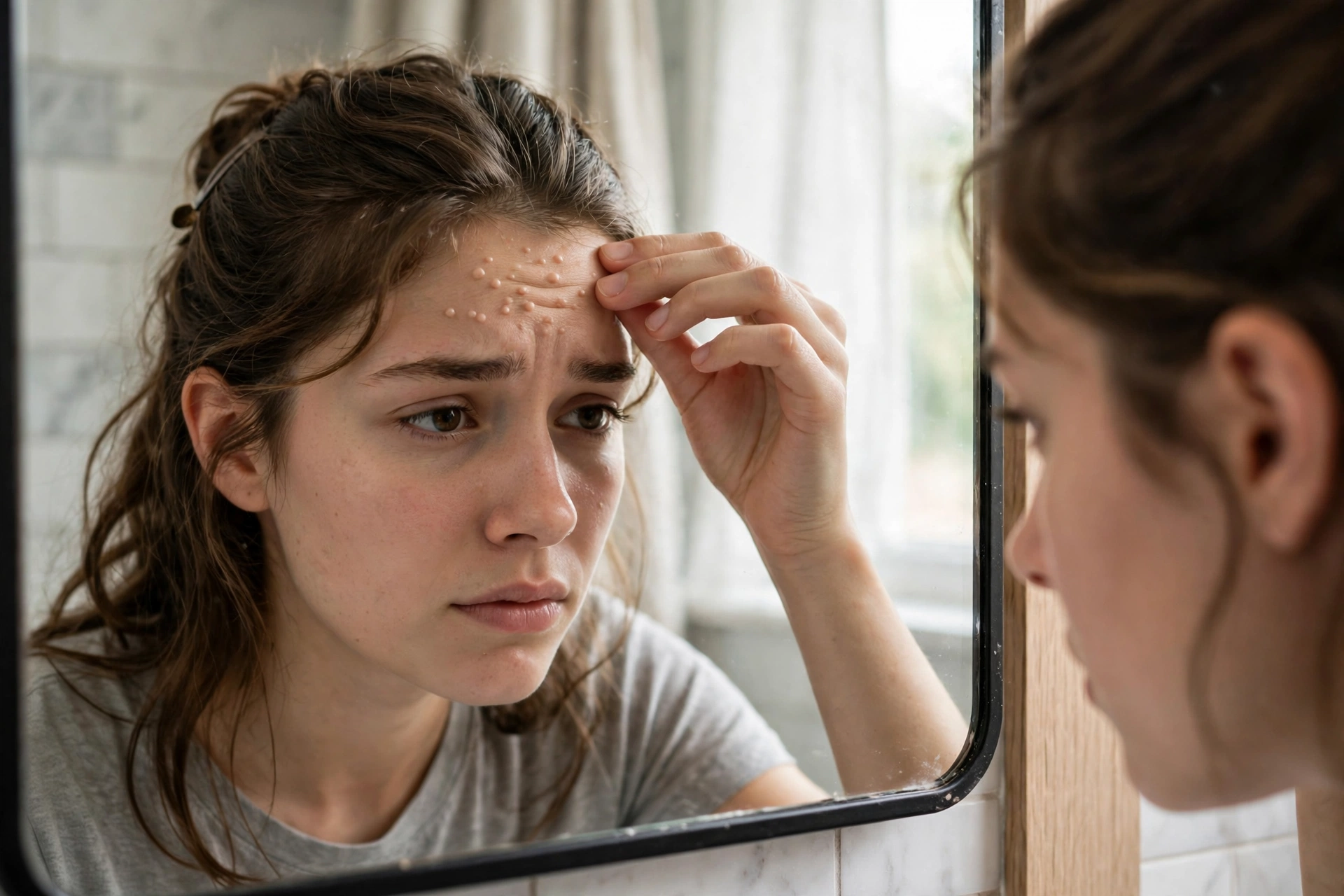
Both common acne and fungal acne present as small reddish bumps and pimples on the surface of the skin. Additionally, both conditions tend to appear in areas rich in sebaceous glands, such as the face, neck, chest, and back. These visual similarities make it easy for individuals to confuse the two conditions at first glance.
Because the lesions look so similar, many people spend months using over-the-counter acne washes without seeing improvement. Misidentifying the eruption allows the underlying yeast overgrowth to continue unchecked.
Despite their identical appearance to an untrained eye, a closer look reveals fundamental differences in bump structure and behaviour. Recognizing these distinguishing characteristics is essential for determining proper skin management.
Key Clues: Identifying the Unique Characteristics of Fungal Acne
One of the most notable diagnostic clues for fungal acne is the presence of significant itching or burning sensations. While bacterial acne pimples may feel tender, inflamed, or painful, fungal breakouts are predominantly itchy. Intense pruritus often prompts individuals to rub or scratch the affected skin, which can further aggravate inflammation.
Another critical feature is the visual uniformity and structural consistency of the bumps. Fungal acne typically consists of small, uniform papules or pustules measuring one to two millimetres in size. All the bumps in a cluster tend to look nearly identical and appear at the same stage of development.
In addition, fungal acne characteristically lacks comedones, meaning there are no blackheads or whiteheads present within the eruption. Traditional acne vulgaris almost always features a mixture of blackheads, whiteheads, papules, and deeper nodules. The complete absence of comedones in a breakout area is a major indicator of a fungal origin.
Location also provides significant guidance when attempting to identify Malassezia folliculitis. Breakouts frequently concentrate on the upper back, chest, shoulders, neck, forehead, and along the hairline. The high concentration of oil glands in these specific areas creates an environment where yeast thrives.
Comparison: Fungal Acne vs. Acne Vulgaris
| Feature | Fungal Acne (Malassezia Folliculitis) | Acne Vulgaris (Common Acne) |
|---|---|---|
| Primary Cause | Overgrowth of Malassezia yeast in hair follicles | Excess sebum, clogged pores, and C. acnes bacteria |
| Key Sensation | Frequently very itchy or burning | Tender, painful, or non-itchy |
| Bump Appearance | Small, uniform (monomorphic) 1–2 mm papules/pustules | Mixed sizes and types (papules, pustules, cysts) |
| Comedones Present | Absent (no blackheads or whiteheads) | Present (blackheads and whiteheads are common) |
| Common Locations | Forehead, hairline, chest, upper back, shoulders | Face (T-zone, cheeks, jawline), chest, upper back |
| Antibiotic Response | No improvement; may worsen or flare | Often improves with targeted antibacterial agents |
Why Ordinary Acne Products and Antibiotics Fail
Standard topical acne formulations containing benzoyl peroxide or salicylic acid are engineered to dissolve sebum plugs and neutralise bacteria. Because yeast organisms possess a fundamentally different cell structure than bacteria, these antibacterial agents cannot eliminate Malassezia.
Prescription antibiotics, whether taken orally or applied topically, create an even greater challenge for individuals with fungal acne. Antibiotics eliminate beneficial skin bacteria that naturally compete with yeast for space and nutrients. When these competing bacteria are reduced, Malassezia yeast gains an opportunity to multiply rapidly.
As a result of this microbial shift, long courses of antibiotics often cause fungal folliculitis to flare or intensify. Many individuals report developing new or worsening breakouts on their chest and back while receiving antibiotic care for facial acne. A failure to respond to antibacterial measures is a classic sign that the diagnosis needs re-evaluation.
Common Triggers and Risk Factors for Yeast Overgrowth
Environmental heat and high humidity are among the most prevalent physical triggers for Malassezia overgrowth. Warm, humid conditions stimulate increased sweating and sebum production, creating a moist environment in which yeast flourishes. Breakouts frequently worsen during hot summer months or after travel to tropical climates.
Excessive sweating combined with tight, non-breathable clothing traps moisture against hair follicles. Wearing synthetic athletic gear or leaving sweaty workout clothes on for extended periods creates an ideal microclimate for yeast proliferation. Promptly removing damp clothing after physical exertion helps minimise this localized moisture accumulation.
Skincare and haircare routines that rely on heavy oils, rich emollients, or occlusive products can also fuel yeast growth. Because Malassezia is a lipid-dependent organism, it feeds on specific fatty acids commonly found in dense facial creams and hair styling products. Applying occlusive products onto oil-prone areas provides external nourishment that supports yeast expansion.
Medical factors such as systemic corticosteroids, immunosuppressive medications, or underlying immune conditions also elevate risk. A compromised or altered immune system reduces the body’s natural capacity to regulate cutaneous yeast levels.
General Care Basics and Daily Skin Hygiene
Adopting supportive daily care habits focuses on maintaining a balanced skin environment without disrupting the protective moisture barrier. Gentle daily care reduces the physical conditions that allow yeast to overgrow.
Showering promptly after heavy sweating or intense physical exercise prevents perspiration from sitting on the skin. Changing out of damp athletic wear and thoroughly drying the chest, back, and shoulders helps keep hair follicles cool and dry. Keeping the skin clean and comfortable after sweating is a fundamental preventive step.
Selecting lightweight, loose-fitting clothing made from breathable fabrics reduces skin friction and heat retention. Simplifying skincare routines by opting for lightweight, non-comedogenic formulas prevents heavy oil accumulation. In addition, keeping hair clean and off the face reduces the transfer of hair oils along the forehead and hairline.
Cleansing the skin gently without aggressive scrubbing protects hair follicles from mechanical damage and irritation. Avoid picking, squeezing, or constantly touching the bumps, as physical friction can worsen follicular inflammation. Maintaining a balanced, gentle routine supports overall skin health while awaiting professional guidance. Structured routines, such as a skin cycling routine, also work best once you know what you are actually treating.
Why a Dermatologist Diagnosis Matters Before Treatment
Self-diagnosing skin eruptions based on social media trends or internet descriptions carries a significant risk of misidentification. Trying unverified home remedies or self-prescribing random products can disrupt the skin barrier and cause secondary dermatitis. Seeking an expert evaluation ensures that any underlying skin issue is accurately identified from the outset.
A board-certified dermatologist possesses the expertise and diagnostic tools needed to distinguish Malassezia folliculitis from other skin conditions. Clinical differentiation is crucial because bacterial acne, bacterial folliculitis, and fungal acne each require distinct management approaches. An accurate diagnostic assessment prevents months of ineffective care and unnecessary drug exposure.
Dermatologists use several specialised in-office tests to confirm a suspected diagnosis. Wood’s lamp examination uses filtered ultraviolet light to check for characteristic yellow-green fluorescence emitted by yeast in hair follicles. Direct microscopic evaluation of skin scrapings or pustule contents using potassium hydroxide (KOH) or methylene blue staining allows rapid visualisation of yeast spores.
In persistent or complex cases, a dermatologist may perform a small skin biopsy to observe yeast inside the hair follicle under histopathology. Microscopic verification confirms whether fungal elements are actively causing inflammation within the pilosebaceous unit.
Furthermore, it is quite common for individuals to experience acne vulgaris and Malassezia folliculitis simultaneously. Clinical studies demonstrate that coexisting bacterial acne and fungal folliculitis occur in a substantial portion of patients. A dermatologist can identify co-occurring conditions and design a tailored, balanced strategy that addresses both aspects safely and effectively. They can also advise whether common acne ingredients, such as azelaic acid, suit your skin or whether the problem is fungal.
This article is general information only and is not medical advice. Please consult a healthcare professional for personal advice.