
As an Amazon Associate, CureTips24 earns from qualifying purchases. We did not test these scales in person; this guide is based on maker specifications, published reviews and research on body composition scales. It is general information, not medical advice.
A smart scale does more than show your weight. It syncs every reading to an app on your phone, draws a graph of your progress over weeks and months, and estimates body composition figures such as body fat, muscle and body water. For many people working on weight loss, seeing the long-term trend instead of one number on one morning is what keeps them motivated.
This guide compares the best smart scales for weight loss, explains how accurate body fat readings really are, and shows you how to weigh yourself in a way that gives you useful, less stressful data.
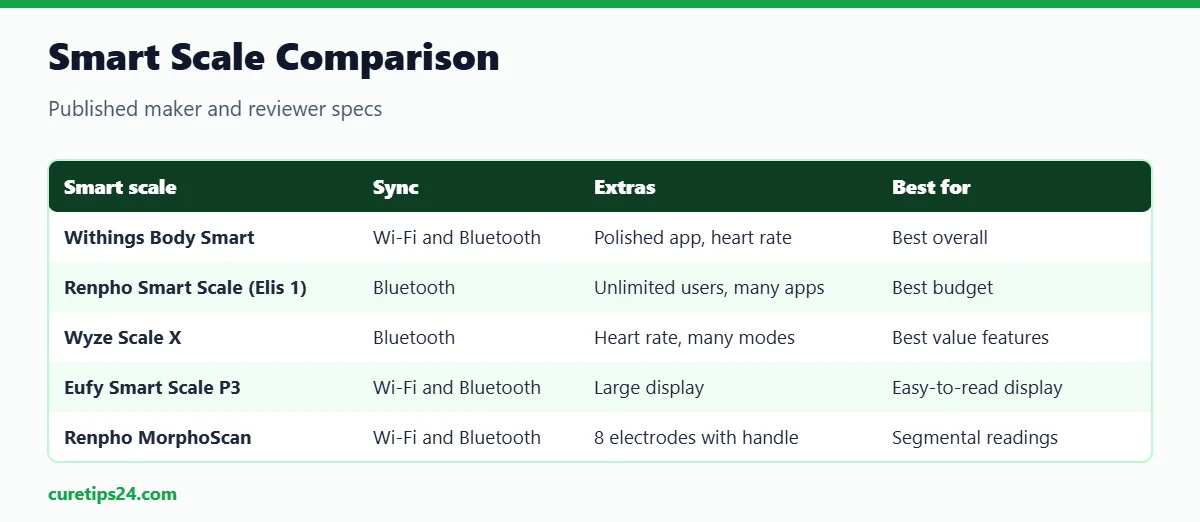
Table of Contents
Quick Picks
- Best overall: Withings Body Smart
- Best budget: Renpho Smart Scale (Elis 1)
- Best value for features: Wyze Scale X
- Easiest display to read: Eufy Smart Scale P3
- Best for more detailed readings: Renpho MorphoScan (8-electrode)
How Accurate Are Smart Scales?
For weight, good smart scales are accurate enough for home tracking. For body fat and other body composition figures, it is important to know what the scale is really doing. Most smart scales use bioelectrical impedance analysis (BIA): they send a tiny, harmless electrical current through your feet and estimate body composition from how easily it travels, combined with the height, age and sex you enter in the app.
Houston Methodist explains that the biggest limitation is that your hydration status affects accuracy, that home scales are generally less sensitive, and that more contact points with your body give a more accurate reading. A 2021 study in JMIR mHealth and uHealth that compared consumer scales to clinical methods concluded that they can be useful for tracking trends and motivation, but are not accurate enough to replace clinical tools.
The practical lesson: treat body fat percentage as a rough estimate, and focus on the direction of your trend over several weeks rather than the exact number on any single day.
1. Withings Body Smart
Best overall. Withings is one of the best-known smart scale brands, and the Body Smart is widely recommended as the best choice for most people. It connects by Wi-Fi as well as Bluetooth, so readings sync automatically without your phone nearby, and it works with Apple Health, Google Fit and Fitbit. Tom’s Guide notes that it tracks weight in 0.1 lb increments. It also estimates body fat, muscle and water, and its app is one of the most polished available. It supports multiple users and recognizes who is stepping on.
Pros: Wi-Fi auto-sync, excellent app, works with major health apps, multi-user.
Cons: pricier than budget scales; body fat is still an estimate like all foot-only scales.
Check the Withings Body Smart on Amazon
2. Renpho Smart Scale (Elis 1)
Best budget. Renpho’s basic smart scale is one of the most popular on Amazon and is often recommended as the best value body fat scale. Tom’s Guide lists it with Bluetooth connectivity, unlimited users and a maximum weight of 396 lbs, and praises how easy it is to use and how much information it gives. The Renpho app syncs with many other health and fitness apps. Because it is Bluetooth-only, you open the app to sync your reading.
Pros: very affordable, easy setup, lots of metrics, unlimited users.
Cons: Bluetooth only; body composition is basic.
Check the Renpho Smart Scale on Amazon
3. Wyze Scale X
Best value for features. The Wyze Scale X packs a lot into a low-cost scale. Live Science describes it as a budget-friendly smart scale with heaps of body composition metrics and a heart rate monitor, though it noted it may not be the easiest option for beginners. It also includes extra weighing modes, such as for weighing luggage, pets or a baby.
Pros: low price, heart rate, many metrics and modes.
Cons: app and features can feel complex at first.
Check the Wyze Scale X on Amazon
4. Eufy Smart Scale P3
Easiest display to read. Eufy’s P3 has a large, clear display, which is helpful if you want to read your results without looking at your phone. Eufy says it measures weight in 0.1 lb (50 g) increments, and it supports Wi-Fi and Bluetooth sync with major health apps. Some reviewers found its body fat readings less consistent than its weight, so it suits people who mainly care about weight trends with a clear display.
Pros: large display, Wi-Fi and Bluetooth, works with major apps.
Cons: body fat estimates may vary; costs more than basic scales.
Check the Eufy Smart Scale P3 on Amazon
5. Renpho MorphoScan (8-Electrode)
Best for more detailed readings. Foot-only scales measure the current between your feet, so they estimate the upper body. Eight-electrode scales like Renpho’s MorphoScan add a handle you hold, so the current also passes through your arms. This allows segmental readings (arms, legs and trunk) and, as Houston Methodist notes, more contact points generally mean more accurate BIA. It costs more and takes a little longer to use.
Pros: hand-to-foot measurement, segmental data, detailed app.
Cons: pricier, bulkier, more steps each time you weigh in.
Check the Renpho MorphoScan on Amazon
What to Look for in a Smart Scale
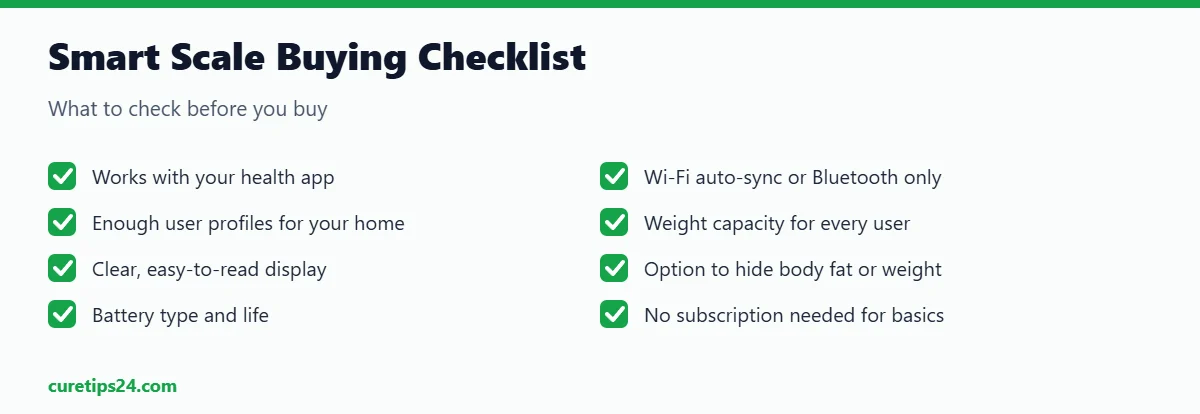
- App compatibility: make sure it syncs with the app you already use, such as Apple Health, Google Fit, Fitbit or a calorie tracker.
- Wi-Fi or Bluetooth: Wi-Fi scales sync automatically; Bluetooth scales need your phone nearby.
- Multiple users: check how many profiles it supports and whether it recognizes users automatically.
- Weight capacity: confirm the maximum weight works for everyone in your home.
- Display: a large, bright display is easier to read, especially without glasses.
- Privacy options: some scales let you hide your weight on the display or show only the trend.
- Power: rechargeable scales save on batteries; others run for months on AAA cells.
- No required subscription: check whether key features are free.
How to Weigh Yourself for Useful Results
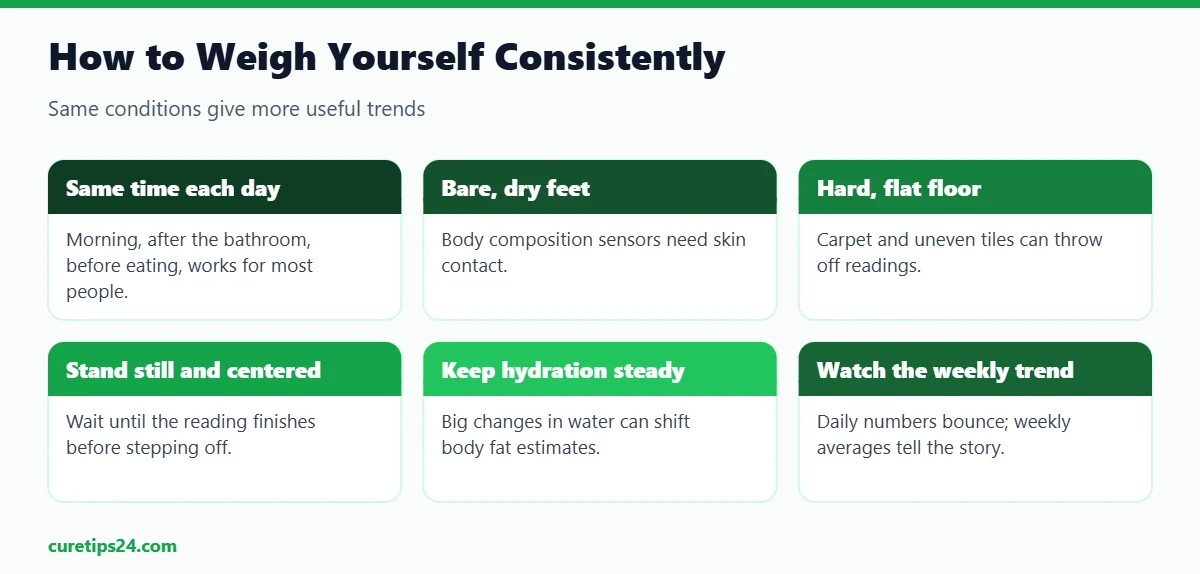
- Weigh at the same time of day, ideally in the morning after using the bathroom and before eating or drinking.
- Use bare, dry feet so the sensors make good contact.
- Place the scale on a hard, flat floor, not carpet.
- Stand still and centered until the reading is complete.
- Avoid weighing right after exercise, a big meal or a lot of fluids, which can shift body composition estimates.
- Focus on weekly averages. Daily weight naturally rises and falls with water, salt, food and hormones.
A day-to-day jump of a pound or two is usually water, not fat. Our guides to how to tell if weight gain is water retention and the difference between fat loss and weight loss explain why.
Keep Your Relationship with the Scale Healthy
A scale is a tool, not a judgment. If daily weigh-ins make you anxious, weigh in less often, use a scale mode that hides the number and shows only the trend, or focus on other markers such as energy, fitness, how your clothes fit, or tape measurements. Our article on inch loss and fat loss covers why measurements can be a useful alternative.
Healthy weight loss is usually gradual. If you are losing weight very quickly without trying, or you feel unwell, talk to a doctor. Read more in how to know if you are losing weight too fast.
Who Should Not Use Body Composition Mode
Smart scale makers commonly advise against using body composition (BIA) features if you have a pacemaker or another implanted electronic medical device, and many advise caution during pregnancy. Most scales let you switch to a weight-only mode. Always check your scale’s manual, and ask your doctor if you are unsure.
Smart Scale Metrics Explained
- Weight: the most reliable number on any scale, and the one to track most closely.
- BMI (body mass index): calculated from your weight and height. It is a quick screening number but does not tell fat from muscle.
- Body fat percentage: an estimate of how much of your weight is fat. Use the trend rather than the exact value.
- Muscle or lean mass: an estimate of everything that is not fat, including muscle, organs and water.
- Body water: an estimate of the water in your body. It changes with hydration, which also shifts body fat readings.
- Bone mass: a rough estimate based on formulas; it is not a bone density test.
- BMR (basal metabolic rate): an estimate of the calories your body uses at rest, calculated from your other figures.
- Visceral fat rating and “metabolic age”: extra estimates some apps show. Treat them as general guides, not medical results.
If you are strength training, your weight may stay steady while your body fat estimate falls and muscle estimate rises. Our guide on losing weight vs gaining muscle explains why the scale alone does not tell the whole story.
Smart Scale vs Basic Digital Scale
A basic digital scale shows your weight and nothing else, and it is cheaper. A smart scale saves every reading automatically, which removes the need to write numbers down and makes trends easy to see. It also adds body composition estimates and syncs with fitness apps. If you only want to check your weight now and then, a basic scale is fine. If you want to track progress over months, a smart scale is worth the small extra cost. See basic digital bathroom scales.
Getting the Most from Your Scale Data
- Connect your apps: linking your scale to a step counter or food diary gives a fuller picture of what is working.
- Set realistic goals: a slow, steady trend is easier to maintain than a fast drop.
- Look at monthly changes: monthly averages smooth out the noise from water and food.
- Pair data with habits: scales measure progress; habits create it. Consistent movement, enough sleep and balanced meals matter most. Our guide to the best time to work out for weight loss can help you plan exercise.
- Keep costs low: you do not need expensive gadgets to succeed. See the easiest ways to lose weight on a budget.
Tips for Sharing a Scale with Family
Most smart scales support several users and guess who is stepping on based on recent weight. If two people weigh about the same, the scale may assign readings to the wrong person, so check the app and reassign if needed. Each person can usually keep their data private in their own account. For children, many apps offer a weight-only mode; talk to your child’s doctor about whether and how often they should be weighed.
Caring for Your Smart Scale
Wipe the glass top with a soft, damp cloth, and avoid harsh cleaners that can damage the electrode coating. Keep the scale on a flat, dry floor, away from steamy showers where possible. Replace batteries when the app warns you, or recharge if your model has a built-in battery. If readings suddenly seem off, move the scale to a hard surface and recalibrate by stepping on and off once.
Frequently Asked Questions
Are smart scales accurate for weight?
Good smart scales are accurate enough for tracking weight at home. Use them on a hard, level floor and in the same spot each time for consistent readings.
Can I trust the body fat percentage?
Treat it as an estimate. It is most useful for spotting trends over weeks when you measure in the same conditions.
How often should I weigh myself?
Some people weigh daily and look at weekly averages; others prefer once a week. Choose what helps you stay consistent and feel positive.
Why does my weight change so much day to day?
Water, salt, carbohydrates, digestion, hormones and exercise all affect short-term weight. Look at the trend over a few weeks.
Do I need Wi-Fi?
No, but Wi-Fi scales sync automatically. Bluetooth scales work well if you do not mind opening the app.
Final Verdict
The Withings Body Smart is our top pick for its automatic Wi-Fi sync, excellent app and wide app compatibility. Choose the Renpho Smart Scale for the best budget option, the Wyze Scale X for the most features for the money, the Eufy Smart Scale P3 for an easy-to-read display, and the Renpho MorphoScan if you want hand-to-foot, segmental readings. Whatever you choose, weigh in consistently and focus on long-term trends.