
Quick Summary / At A Glance
- There is no strong clinical proof that castor oil grows new hair.
- Its real strength is deep conditioning: moisturised hair breaks less and keeps its length, so it can look fuller over time.
- Always mix it with a lighter oil such as coconut or almond, and use just a teaspoon or two.
- Leave it on for one to two hours, or overnight, then wash it out thoroughly.
- Once a week is enough for most people; build-up is the clearest sign you are overdoing it.
The honest answer is that there is no strong clinical proof that castor oil grows new hair. What it does well is different, and still useful: it is a very thick, rich oil that deeply conditions hair, adds moisture, and helps reduce breakage.
Hair that breaks less can keep its length and look thicker and healthier. If you use castor oil with that realistic expectation, it can be a valuable part of your routine.
Table of Contents
What castor oil is
Castor oil is pressed from castor beans and is rich in ricinoleic acid. It is much thicker and stickier than most other hair growth oils, which is both its strength and its drawback.
A little coats the hair shaft well and locks in moisture, but too much is hard to spread and even harder to wash out.
Castor oil is pressed from the seeds of the Ricinus communis plant. About 90% of its fatty acids are ricinoleic acid, which makes it unusually thick and sticky compared with other plant oils.
Does it really grow hair? The honest evidence
There is no strong clinical proof that castor oil grows new hair or reverses hair loss. Claims that it speeds up growth are not backed by solid studies.
Its real value is deep conditioning: moisturised hair is more flexible, tangles less, and snaps less during brushing and styling. Over months, less breakage means the hair you grow is the hair you keep, so your lengths can look fuller.
That is a genuine benefit, but it is not the same as growing new hair from the scalp.
It also helps to separate two things that are often confused: shedding, where hair falls from the root, and breakage, where it snaps along the shaft. Castor oil can only help with the second; if you are seeing a lot of shedding, oil is not the answer and a doctor is the right next step.
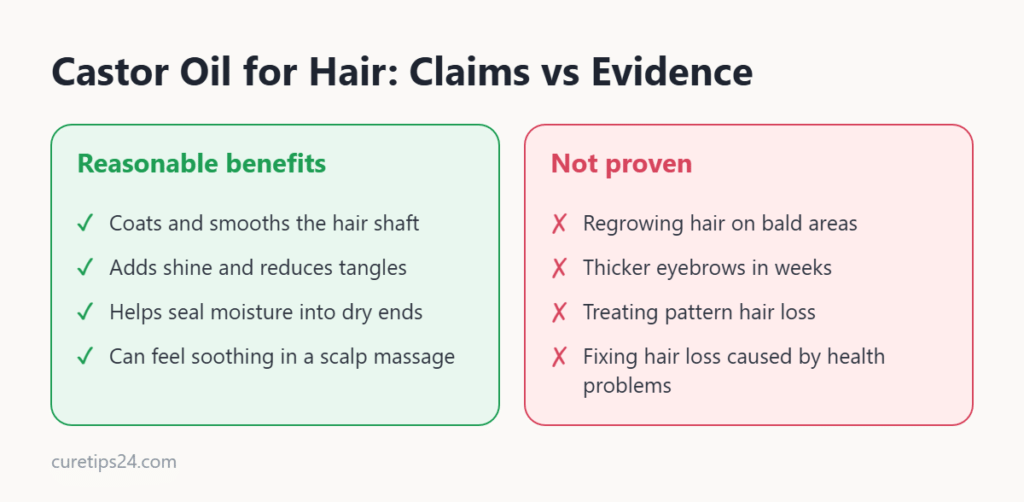
If you are noticing real thinning, the cause matters more than the oil. The American Academy of Dermatology lists common causes of hair loss, and the NHS explains which types are temporary. For an option with a small study behind it, see our guide to rosemary oil for hair.
Choosing a castor oil: what to look for
Choose a plain castor oil with castor oil as the only ingredient, rather than a blend padded out with fragrance. A simple oil behaves predictably, mixes cleanly with your lighter oil, and makes patch testing more meaningful.
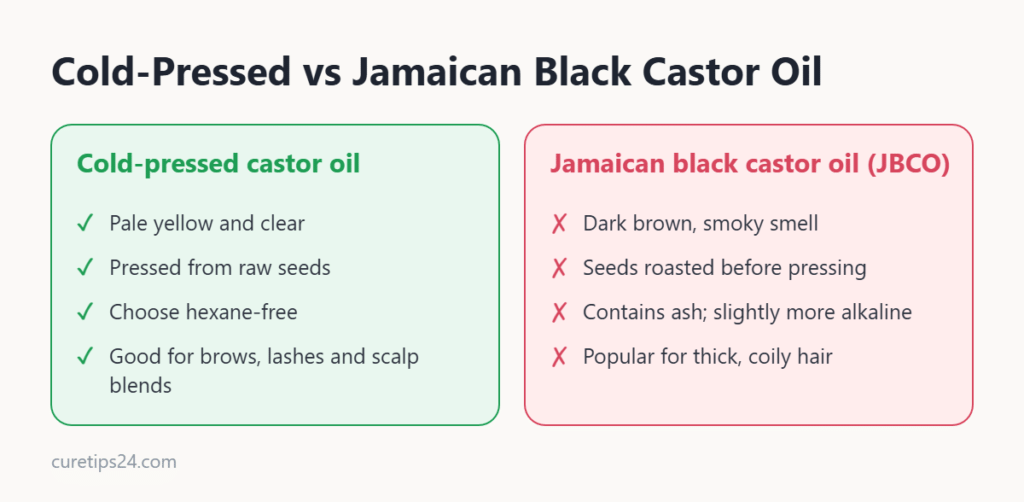
You will see bottles described as cold-pressed or Jamaican black castor oil; for home use, the noticeable differences are colour and scent rather than proven results. Whichever you pick, store it with the lid on, away from direct heat, and replace it if it starts to smell stale.
How to use castor oil, step by step
Step 1: Mix it with a lighter oil
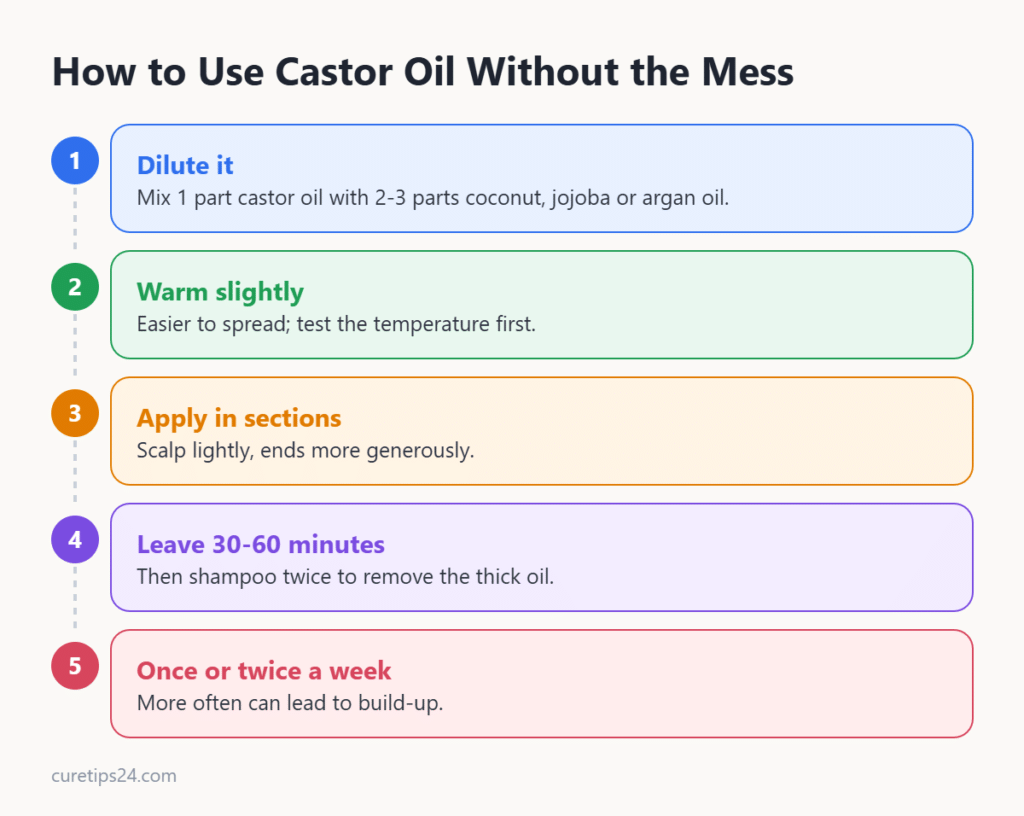
Because castor oil is so thick, mix it with a lighter oil such as coconut or almond oil. Half and half is a good starting point.
This makes it easier to apply evenly and much easier to wash out later. The mixing idea is similar to diluting a strong oil, as explained in our rosemary oil guide.
Step 2: Warm it slightly and use a small amount
Warm the mixture gently between your palms or by standing the container in warm water for a few minutes. Use small amounts: a teaspoon or two is enough for most heads of hair.
You can always add more, but removing excess is a second shampoo.
Step 3: Patch test, then massage it in
If you have not used castor oil before, do a patch test first: dab a little behind your ear, wait 24 hours, and check for any reaction. Then massage the oil into your scalp with your fingertips and smooth the rest through the lengths, where breakage usually happens.
Step 4: Leave it, then wash it out thoroughly
Leave it on for one to two hours, or overnight if you prefer, protecting your pillow with a towel. Wash it out thoroughly with shampoo, working the shampoo through before you add lots of water.
Thick oil often needs two shampoos, and that is normal. Rinse until your hair feels clean, not coated.
| Castor oil routine at a glance | Guide |
|---|---|
| Mix | Half castor oil, half a lighter oil such as coconut or almond |
| Amount | A teaspoon or two for most heads of hair |
| Time on hair | One to two hours, or overnight with your pillow protected |
| How often | Once a week is enough for most people |
| Washing out | Shampoo worked through before lots of water; two shampoos is normal |
Castor oil and different hair types
Dry, coarse and thick hair usually gets the most from castor oil, because it can handle a rich oil without collapsing. Curly hair that loses moisture quickly also tends to suit it, especially on the ends.
Fine hair is the opposite case: even a small amount can flatten it. If your hair is fine, use a mix with more light oil than castor, keep it mainly on the lengths, and wash it out after an hour or two rather than leaving it overnight.
If your scalp is oily, apply the mix to the lengths and ends and keep any scalp massage light, or skip the scalp altogether. The conditioning benefit is mostly in the hair itself.
Common mistakes to avoid
- Using it neat and in large amounts, then struggling to remove it.
- Applying it too often, which causes build-up that makes hair look dull and heavy.
- Expecting new growth in a few weeks and giving up on basic hair care when it does not appear.
Build-up is the clearest sign of overuse. If your hair feels weighed down even after washing, use less oil, mix in more of the lighter oil, and take a break for a week or two.
Safety notes
Patch test a new oil before your first full use, as described in step 3, and repeat the test if you switch to a different product. Keep castor oil away from your eyes, and wash it out and stop using it if your scalp becomes sore, itchy or irritated.
Avoid applying any oil to broken or inflamed skin; let the scalp settle first. If irritation keeps coming back, the oil is not for you, however popular it is.
What to expect, honestly
Oils support hair and scalp care and appearance. They do not cure baldness or guarantee regrowth, and castor oil is no exception.
Expect softer, better-conditioned hair that breaks less and may look thicker as it keeps its length. Judge the results after a few months of sensible use, once a week or so, rather than after one application.
If you are losing hair quickly or in patches, see a doctor for a proper assessment.
Frequently asked questions
How often should I use castor oil?
Once a week is enough for most people, because it is so rich. More often usually means more build-up.
Can I leave castor oil on overnight?
Yes. Cover your pillow, and allow time in the morning to wash it out properly, possibly with two shampoos.
Why is my hair still greasy after washing?
You probably used too much. Use a smaller amount next time and mix it with more light oil.
How long before I see a difference?
Judge it over a few months of weekly use, not a few days. The first changes are usually in condition — softer hair that tangles and snaps less — rather than in growth.
Key takeaways
- No strong proof castor oil grows new hair; its strength is conditioning and less breakage.
- Mix it with a lighter oil, use small amounts, and warm it slightly.
- Leave one to two hours or overnight, then wash out thoroughly.
- Watch for build-up, the main sign you are overdoing it.
Keep reading: Rosemary Oil for Hair Growth: How to Use It Correctly and How Often Should You Apply Hair Growth Oil?.
This article is general information only and is not medical advice. Please consult a healthcare professional for personal advice.

3 thoughts on “Castor Oil for Hair Growth: Does It Really Work?”