
Quick Summary / At A Glance
- Always dilute: a few drops of rosemary oil in a tablespoon of carrier oil — never apply it neat.
- Patch test first, then massage the mixture into the scalp and leave it for at least 30 minutes before shampooing out.
- Use it two to three times a week, fitted around your normal wash days.
- One small 2015 study is promising but not proof; any change takes months, not weeks.
- Stop if irritation persists, and check with a healthcare professional first if you are pregnant or have a scalp condition.
To use rosemary oil for hair growth correctly, dilute a few drops in a tablespoon of carrier oil, massage it into your scalp, leave it for at least 30 minutes, then shampoo it out. Repeat two to three times a week.
That simple routine is the whole method.
Done consistently and safely, rosemary oil can support scalp care and help your hair look healthier. It is not a cure, and it will not work overnight.
Table of Contents
What rosemary oil is, and what it can do
Rosemary oil is an essential oil made from the rosemary herb. Essential oils are concentrated, which is why rosemary oil should never be applied neat to the scalp.
Among hair growth oils, it is popular because it is widely available, affordable, and easy to add to a pre-wash routine. Used that way, it is simple and inexpensive — the main skills are dilution and patience.
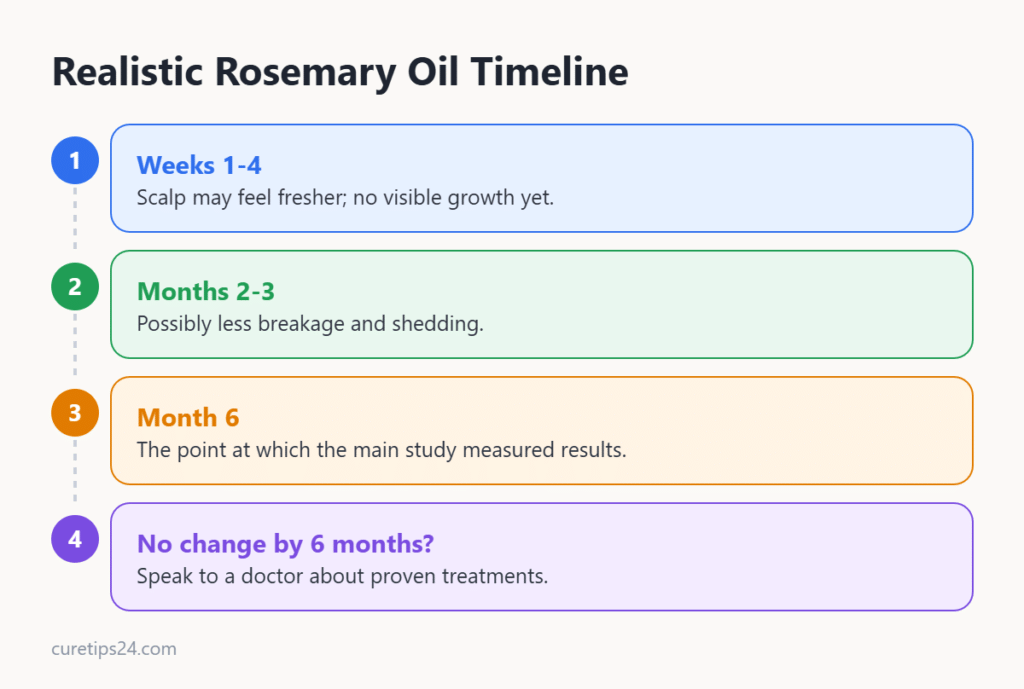
One small 2015 study found rosemary oil performed comparably to 2% minoxidil for pattern hair loss after 6 months. That finding is often shared online, so it needs to be described exactly that way: one small study, not proof.
It does not mean rosemary oil works for everyone, and it does not replace medical treatment for hair loss. It is a promising result that needs more research, not a guarantee.
What you need before you start
- Rosemary essential oil
- A carrier oil: coconut, jojoba or olive oil
- A tablespoon and a small bowl
- Your usual shampoo
- A towel to protect your clothes
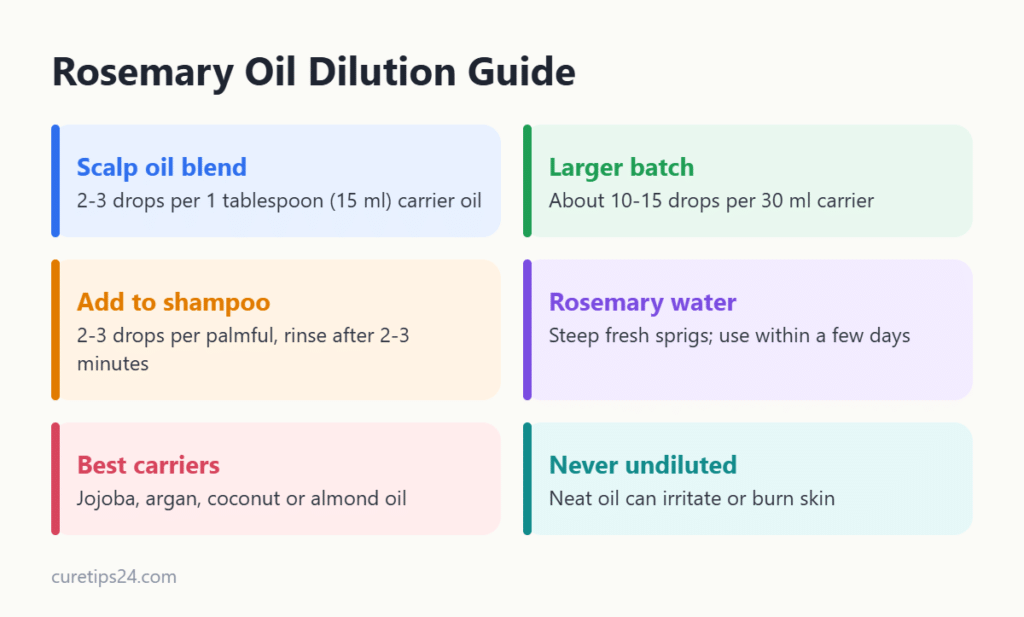
Choose a carrier oil you already tolerate well. Jojoba feels lighter, coconut oil is richer, and olive oil is a good budget option most people have at home.
| Carrier oil | Feel on the scalp | A good choice when |
|---|---|---|
| Jojoba | The lightest of the three | Your scalp is quick to feel greasy, or you want the lightest finish |
| Coconut | Richer | Your hair and scalp are dry and you want more moisture |
| Olive | In between | You want a budget option most people have at home |
How to use rosemary oil for hair growth, step by step
Step 1: Dilute it properly
Add a few drops of rosemary oil to a tablespoon of carrier oil and mix. This dilution is the most important safety step.
Undiluted essential oil can irritate the scalp, cause redness, or make the skin sensitive over time. More drops do not mean faster results.
Step 2: Do a patch test first
Before your first full application, dab a little of the diluted mixture behind your ear or on your inner elbow. Wait 24 hours.
If there is no itching, burning or redness, you can go ahead. If your skin reacts, wash it off and do not use the mixture.
Step 3: Massage it into the scalp
Part your hair in sections and apply the mixture to the scalp, not just the lengths. Massage gently with your fingertips, not your nails, for a few minutes.
Work section by section so the coverage is even and you do not use more oil than you need.
Step 4: Leave it on
Leave the oil on for at least 30 minutes. You can leave it overnight if that suits your routine, covering your pillow with a towel.
Longer is not automatically better, so if your scalp feels irritated at any point, wash it out straight away.
Step 5: Shampoo it out
Wash the oil out thoroughly with shampoo, focusing on the scalp. Rinse well.
Your hair should feel soft, not greasy. If it still feels heavy, you used too much oil or did not rinse enough.
Use a little less next time.
Common mistakes to avoid
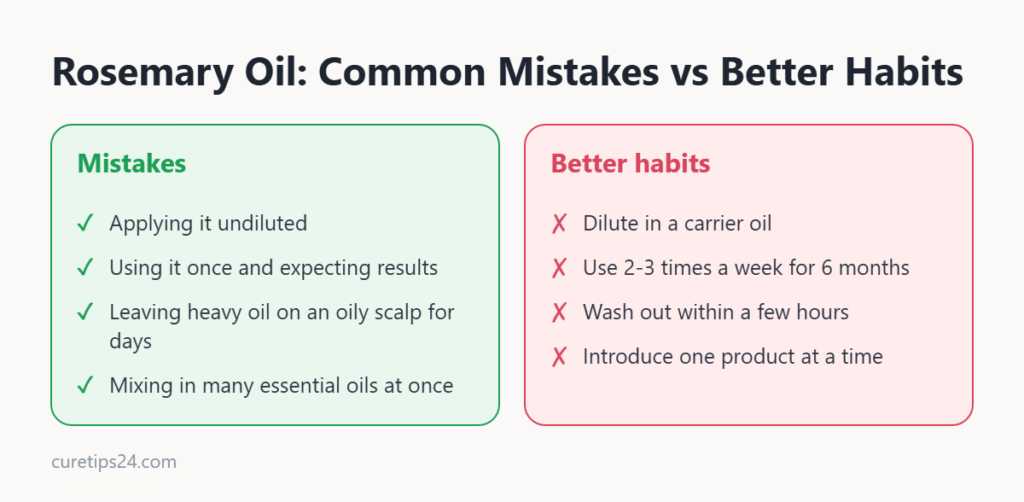
Most problems with rosemary oil come from the same few errors.
- Using it neat, or adding extra drops for faster results — more drops do not mean faster results; they mean more irritation risk.
- Skipping the patch test because it is “natural” — concentrated essential oils can still irritate or sensitise skin.
- Applying it to the lengths instead of the scalp — the routine targets the scalp, and lengths just use up oil.
- Leaving it on despite irritation — wash it out straight away if your scalp complains; longer is not better.
- Judging it after a fortnight — hair grows slowly, so give it months of consistent use before you decide.
Rosemary is a fragrance ingredient, and DermNet lists essential oils among common causes of fragrance allergy. Stop if you notice redness, burning or itching.
How often should you use it?
Two to three times a week is a practical routine for most people. That is frequent enough to be consistent without leaving constant build-up.
Fit it around your normal wash days, for example as a pre-wash treatment, so it becomes a habit you can actually keep. If twice a week is all you can manage, that is fine — a routine you keep beats an ambitious one you abandon.
A simple note of when you started, plus a monthly photo in the same light, makes judging progress far easier than memory.
Safety notes
Always dilute rosemary oil, always patch test first, and stop using it if you get persistent irritation, itching or flaking.
Keep it out of your eyes, and wash your hands after applying it.
If you are pregnant, have a scalp condition, or take medication for hair loss, check with a healthcare professional before adding a new product to your routine.
The rosemary study was in men with pattern hair loss, described in detail by DermNet. Shedding from other causes needs a different approach; the NHS explains when to see a GP. For the evidence in more detail, see our guide to what the rosemary oil evidence says, or try our homemade hair oil recipe as a base, and keep your scalp healthy with our beginner scalp care routine.
What to expect, honestly
Oils support hair and scalp care and appearance. They do not cure baldness or guarantee regrowth.
If rosemary oil helps you, any change will be slow: results, if any, take months of consistency, not days or weeks. Judge it after several months of regular use, and take photos in the same light if you want a fair comparison.
If hair loss is rapid, patchy or worrying, see a doctor rather than relying on oil alone.
Frequently asked questions
Can I apply rosemary oil directly to my scalp?
No. It is an essential oil and must be diluted in a carrier oil first, as described above.
Can I leave it on overnight?
Yes, if your patch test was fine and your scalp feels comfortable. Protect your pillow and wash it out in the morning.
How long until I see a difference?
Allow months, not weeks. Hair grows slowly, and no oil can change that.
Can I mix rosemary oil with other essential oils?
Keep it simple while you learn how your scalp responds: one essential oil, properly diluted, is enough. If you later blend oils, keep the total drops the same rather than adding more, and patch test the new mixture.
Key takeaways
- Dilute a few drops in a tablespoon of carrier oil.
- Patch test first, massage into the scalp, leave at least 30 minutes.
- Use two to three times a week and shampoo out well.
- Expect slow, modest support for hair care, not a cure.
Keep reading: Onion Oil for Hair Growth: Benefits, How to Use It and What to Expect and How Often Should You Apply Hair Growth Oil?.
This article is general information only and is not medical advice. Please consult a healthcare professional for personal advice.

6 thoughts on “Rosemary Oil for Hair Growth: How to Use It Correctly”