Table of Contents
Quick Summary / At A Glance
- Level 6 sits on the dividing line between blonde and brown in the professional hair colour level system.
- On professional charts, level 6 is classed as dark blonde, the darkest shade in the blonde family.
- In everyday light it often looks like light brown, which is why it is also called bronde or dirty blonde.
- Undertone, lighting, texture and natural highlights decide whether it reads warmer and blonder or cooler and browner.
- Regular toning, gentle washing and colour-safe care help to limit brassiness, fading and darkening.
Is Level 6 Hair Dark Blonde or Light Brown?
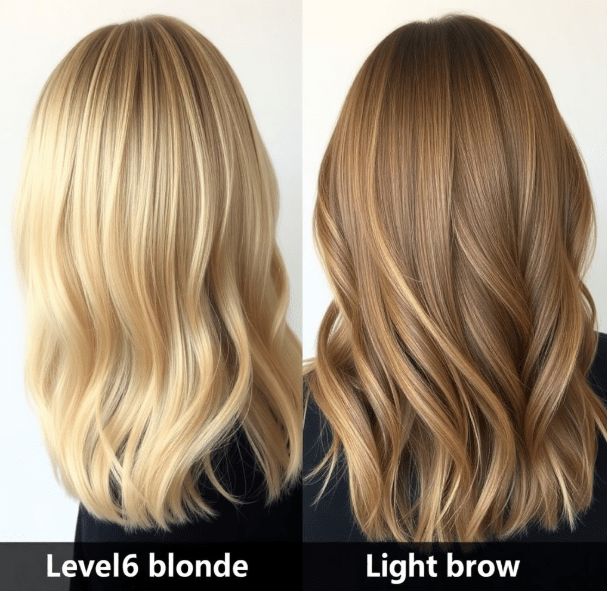
In the world of hair colour theory, level 6 stands as the dividing line between the blonde and brunette spectrums. It is technically classified as dark blonde on professional colour charts, yet it is frequently perceived by the naked eye as light brown.
This disconnect between classification and visual perception makes level 6 a source of confusion for clients and a complex subject for colourists. This guide explains the level system, the role of undertones, and how to choose, maintain and correct a level 6 shade.
What Level 6 Means in the Hair Colour Level System
Hair colour uses a standardised numbering system, called the Level System or Depth Scale, that helps professionals communicate about hair colour depth accurately. The system ranges from 1 (blackest black) to 10 (lightest blonde).
Generally, levels 1 to 5 are considered brown, while levels 6 to 10 are blonde shades. Level 6 falls right in the middle of this spectrum, which explains much of the debate around it.
Level 6 is lighter than a typical medium brown but darker than what many people picture as blonde. It often appears as a rich, warm tone that can lean golden or ashy depending on the underlying pigments.
Why Level 6 Is Classed as Dark Blonde
According to the International Color Chart (ICC) and most professional beauty schools, level 6 is classified as dark blonde. It is the darkest shade in the blonde family.
Level 6 contains fewer underlying warm pigments than level 5 (light brown). It often has a yellowish undertone when lightened, which is characteristic of blonde hair.
Professional colourists also note that not all hair is uniformly the same colour. The majority of the hair on your head typically falls into one category, while natural highlights or lowlights create variation.
Why Level 6 Often Looks Like Light Brown
Despite its technical classification, many people perceive level 6 as light brown. It is darker than what is typically associated with blonde in popular culture, and it can appear more brown than blonde in certain lighting conditions.
The hair may also exhibit more orange undertones than yellow when lightened, a characteristic more common in brown hair. This is why some stylists use the descriptive terms bronde, a blend of blonde and brown, or dirty blonde for level 6 hair.
Level 6 Blonde and Brown Hair Compared
| Aspect | Dark blonde reading | Light brown reading |
|---|---|---|
| Place on the chart | Darkest shade in the blonde family, within levels 6 to 10 | Just above the brown levels, 1 to 5 |
| Undertone when lightened | More yellow | More orange |
| Effect of light | Natural light pulls out the blonde | Indoor lighting emphasises the brown |
| Effect of undertone | Golden tones look lighter and blonder | Ashy tones look darker and browner |
| Common descriptions | Dark blonde | Bronde or dirty blonde |
What Changes How Level 6 Looks
Several factors affect whether level 6 hair is perceived as blonde or brown. Level 6 hair often has natural variations, with lighter strands appearing more blonde.
Lighting makes a significant difference, because colour perception differs between natural daylight and artificial lighting. Texture matters too, as curls and volume add shadows that deepen the appearance.
Undertones shift the result in either direction, as the comparison table above shows. Personal experiences and cultural backgrounds can also influence colour perception, so two people may describe the same hair differently.
How to Tell Whether Your Hair Is Level 6
Compare your hair to professional colour charts in natural daylight. Look at the bulk of your hair, not just highlights or sun-damaged ends.
Converting a photo of your hair to black and white can remove colour bias and help you match it to level 6 on the scale. If you are unsure, consult a professional colourist who can accurately assess your level.
Choosing a Level 6 Shade for Your Skin Tone
Level 6 hair is versatile and can flatter a wide range of skin tones when it is customised correctly. Understanding how undertones interact with your complexion helps you choose between golden, ashy and neutral variants.
Fair and light skin tones: Golden undertones appear warm and glowing, enhancing natural radiance. Ashy undertones create a cool contrast that highlights light eyes, and cooler skin tones benefit from ashy level 6, while warmer complexions suit golden variants.
Medium skin tones: Level 6 creates natural-looking dimension without appearing jarring. Warm golden tones complement olive or golden undertones, while ashy variants work well with cooler, more neutral complexions.
Deep and dark skin tones: Rich golden tones create contrast and enhance radiance, and warm undertones bring out the depth and richness of darker skin. Cooler ashy tones give a more muted appearance, so warm variants are generally more flattering unless you prefer that muted effect.
Before committing to a permanent change, consult a professional colourist who understands colour theory and your undertone. They can recommend the best level 6 variant, golden, ashy or neutral, for your specific complexion.
Making Level 6 Look Blonder or Browner
For a blonder look, use purple-based toners to neutralise yellow undertones. For a browner appearance, opt for ash-based colours to enhance cooler, browner tones.
Regular toning can help maintain the desired shade and prevent brassiness. The undertone you choose is the main tool for steering level 6 towards blonde or brown.
Level 6 hair can have golden, ashy, copper or neutral undertones. The undertone depends on the specific hair dye used and your natural hair’s underlying pigmentation, with golden undertones leaning warmer and ashy undertones appearing cooler.
How Long Level 6 Colour Lasts and How to Maintain It
Maintaining level 6 hair colour requires consistency and proper care. Most semi-permanent dyes last 4 to 6 weeks before fading, while permanent colour lasts until the hair grows out, typically 4 to 8 weeks.
The frequency of touch-ups depends on your natural hair growth rate and how quickly the colour oxidises. To extend colour longevity, follow the care points below.
- Use sulphate-free shampoo and conditioner formulated for colour-treated hair.
- Apply colour-depositing conditioners weekly to refresh vibrancy.
- Limit washing to 2 to 3 times per week.
- Use heat protectants when styling.
- Schedule trims every 4 to 6 weeks to remove damaged ends.
- Avoid chlorinated pools without wetting the hair first as a pre-treatment.
Colour Shifts at Level 6: Brassiness, Darkening and Fading
Level 6 hair is particularly susceptible to colour shifts due to its position in the spectrum. Understanding common colour shifts helps you address them before they become problematic.
- Brassiness: Warm, yellow-orange tones become more prominent as the colour fades, when underlying pigments show through.
- Darkening: Environmental factors, product build-up or heat damage can cause level 6 to appear darker and more muted.
- Fading: Semi-permanent dyes fade to a lighter, often washed-out appearance after 4 to 6 weeks.
Correcting Common Colour Shifts
For fading, refresh the colour with semi-permanent dye or root touch-ups to maintain consistency. Alternatively, use colour-depositing conditioners between professional treatments.
For brass tones, apply purple-toning masks or use purple shampoos to neutralise warm undertones. Do this once weekly or as needed.
For darkness, light ash toners can brighten the colour and cool down warm tones. Consider a glossing treatment at your salon every 6 to 8 weeks.
Frequently Asked Questions About Level 6 Hair Colour
Q: Is level 6 hair naturally blonde or brown?
A: Level 6 hair is technically classified as dark blonde by professional standards and colour charts. However, perception varies with individual hair characteristics, lighting and personal interpretation, and many people perceive it as light brown.
Q: Can I go from level 6 to a lighter blonde?
A: Yes, you can lighten level 6 hair by 1 to 2 levels using permanent or demi-permanent dye without bleaching. To go significantly lighter, you will need bleach, which should be applied by a professional stylist to avoid damage.
Q: What is the difference between bronde and level 6?
A: Bronde is a descriptive term meaning a blend of blonde and brown, often used to describe level 6 hair. Level 6 is the technical classification, while bronde describes the same colour from a different perspective.
The Verdict: Dark Blonde by Definition, Bronde by Nature
Technically, level 6 is dark blonde. It sits at the boundary of the colour chart, serving as the darkest shade of the blonde family before crossing into brunette territory.
In practice, level 6 is the chameleon of hair colour. Whether it reads as a deep, rich blonde or a sun-kissed light brown depends on lighting, texture and undertones.
Do not get hung up on the label. Because this shade exists in the bronde transition zone, a professional colourist can customise the undertones to suit your complexion, so the colour looks intentional rather than ambiguous.
This article is general information only and is not medical advice. Please consult a healthcare professional for personal advice.