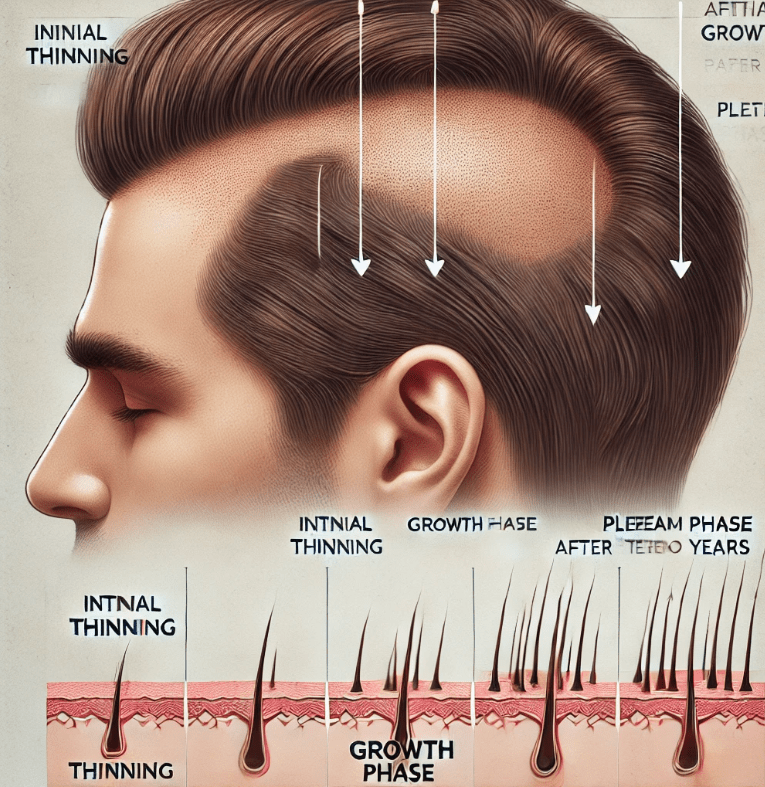
Does Minoxidil stop working after 2 years? This is a question many people using the medication ask themselves. So, you’ve been on the Minoxidil (Rogaine) train for a while. Maybe it’s been a year, maybe two. In the beginning, it was exciting—you saw the baby hairs popping up, the density improving, and you felt like you finally cracked the code on hair loss.
But lately? It feels like things have stalled. Maybe you’re even noticing a little more shedding than usual. This leads to the big, scary question that plagues almost everyone in the hair loss community: “Does this stuff stop working after two years?”
The short answer is: No, it doesn’t stop working. But the long answer is a little more complicated (and actually kind of reassuring).
Let’s break down exactly what is happening to your scalp, why it feels like it stopped, and what you can do about it.
Table of Contents
Does Minoxidil Stop Working After 2 Years? Understanding the Plateau Phase
First off, let’s manage expectations. When you first start Minoxidil, you are essentially waking up hair follicles that were asleep or “miniaturized.” That initial kickstart creates a visual boom of growth.
However, scientific studies on Minoxidil show that peak results usually happen around the 1-year to 2-year mark.
After that first big wave of regrowth, the medication shifts gears. It moves from a “regrowth phase” to a “maintenance phase.”
- Year 0-2: You see the “Wow” factor. New hairs, thicker strands.
- Year 2+: You hit a plateau. You aren’t seeing more new hair, so it feels like it stopped working.
Think of it like going to the gym: When you first start lifting weights, you see massive “newbie gains” in the first year. After two years, you stop getting noticeably bigger every single month. You didn’t stop working out, and the weights didn’t stop working. You just hit your peak potential. Now, you lift to maintain that muscle.
Why Does Minoxidil Stop Working After 2 Years? You’re Fighting Progressive Hair Loss
This is the most important part to understand. Male (and Female) Pattern Baldness is progressive. It never sleeps. It is constantly trying to shrink your hair follicles.
As you get older, the genetic signal to lose hair often gets stronger.
- Without Minoxidil: You might have lost 50% of your hair by now.
- With Minoxidil: You have maybe maintained the same amount of hair you had two years ago.
If your hair looks exactly the same as it did two years ago, Minoxidil is working incredibly well. It is holding the line against a tidal wave of genetic hair loss. If you were to quit today, you wouldn’t just stay where you are; you would likely lose all the hair Minoxidil was protecting within 3 to 6 months.
3. The “Second Shed” Phenomenon
Another reason people freak out around the 2-year mark is the synchronization of hair cycles.
Hair grows in phases:
- Anagen: Growth.
- Catagen: Transition.
- Telogen: Resting/Shedding.
Minoxidil forces a lot of follicles into the growth phase at the exact same time. That’s great at first. But, because they all started growing at the same time, they often decide to shed at the same time later down the road.
If you suddenly see a shed after 2 years, it doesn’t mean the drug stopped working. It often means your hairs have synchronized their cycles and are shedding together to make room for new growth. Ride it out—it usually bounces back.
Why It Might Actually Fail (and How to Fix It)
While the drug itself doesn’t “expire,” there are human factors and biological changes that can mess up your results.
1. You Got Lazy (The Consistency Trap)
Be honest with yourself. In the first year, you probably applied it religiously twice a day, never missing a beat. Two years in? Maybe you skip weekends. Maybe you only do it once a day. Maybe you forget a few nights a week.
- The Fix: Minoxidil has a very short half-life. It needs to be on your scalp to work. Get back to a strict schedule.
2. Your Scalp Health Changed
If you have buildup of dandruff, sebum (oil), or product residue, the Minoxidil solution might not be absorbing into the skin as well as it used to.
- The Fix: Use a Ketoconazole shampoo (like Nizoral) once or twice a week. It cleans the scalp and has mild anti-androgen properties that help fight hair loss.
3. The Enzyme Issue (SULT1A1)
Here is the nerdy part: Minoxidil needs an enzyme in your scalp called sulfotransferase to convert into its active form (Minoxidil Sulfate). Some people have less of this enzyme over time, or they just didn’t have much to begin with.
- The Fix: Some dermatologists recommend adding Tretinoin (Retin-A) to your regimen. Tretinoin is usually for acne, but it has been shown to boost the sulfotransferase enzyme in the scalp, making Minoxidil work stronger. Ask a doctor before trying this.
Is It Time to Call in Reinforcements?
If you are definitely losing ground after 2 years despite being consistent, Minoxidil alone might not be enough anymore. Remember, Minoxidil is a growth stimulant, but it doesn’t actually stop the root cause of hair loss (DHT hormones).
It’s like trying to fill a bucket with water (Minoxidil) while there is a hole in the bottom (DHT). Eventually, the hole gets too big.
You might need to add:
- Finasteride: This is the medication that stops the DHT hormone from attacking the hair. It plugs the hole in the bucket.
- Microneedling (Derma rolling): Using a dermaroller once a week creates tiny micro-injuries that rush blood and collagen to the area. Studies show that Microneedling + Minoxidil works way better than Minoxidil alone.
The Bottom Line: Does Minoxidil Stop Working After 2 Years?
Does Minoxidil stop working after 2 years? Technically, no. But the visual “magic” fades.
You move from the exciting “Regrowth Phase” to the boring (but crucial) “Maintenance Phase.” If you are holding your ground and not going bald, the medication is doing its job.
Your Game Plan:
- Don’t Panic: Do not stop using it, or you will lose the gains.
- Check Your Routine: Are you being consistent?
- Add Tools: Consider adding Microneedling or switching to a Ketoconazole shampoo.
- Talk to a Doc: If you are losing ground, it might be time to discuss Finasteride to stop the hormonal attack.
Hang in there. Hair loss is a marathon, not a sprint!