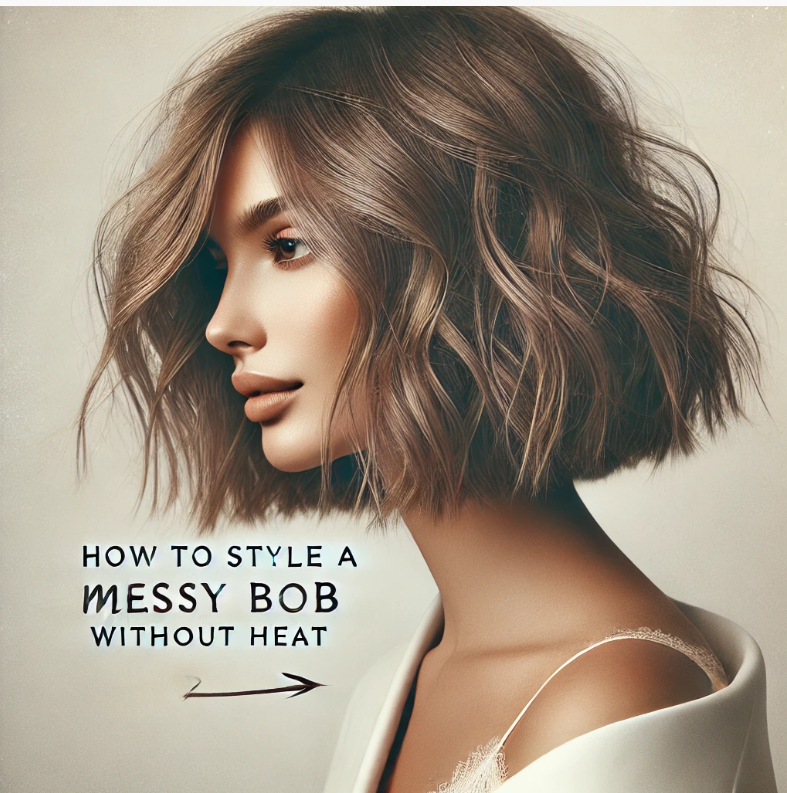
Adopting a French bob is a sculptural transition from long hair to a shorter silhouette defined by character and effortless chic. For minimalists, the beauty of this cut lies in its natural movement and the decision to skip heat tools. This guide explains how to style a messy bob without heat, turning difficult texture into your greatest styling asset.
Table of Contents
The French Bob Philosophy: Embracing Movement and Intentional Disarray
The French Bob is less about a “perfect” finish and more about a feeling of effortless elegance. It thrives on what many mistakenly call “weird texture.” In this aesthetic, a cowlick is not a flaw; it is a structural detail. Frizz and natural bends provide the necessary volume to ensure the cut doesn’t look flat or uninspired.
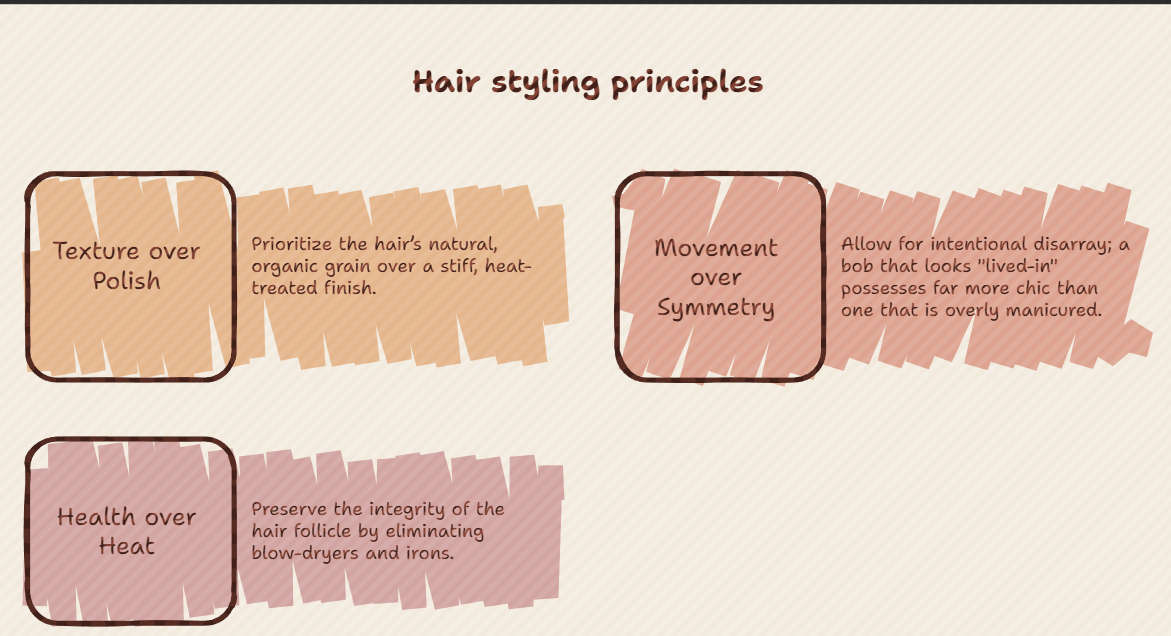
The French Bob Manifesto
- Texture over Polish: Prioritize the hair’s natural, organic grain over a stiff, heat-treated finish.
- Movement over Symmetry: Allow for intentional disarray; a bob that looks “lived-in” possesses far more chic than one that is overly manicured.
- Health over Heat: Preserve the integrity of the hair follicle. By eliminating blow-dryers and irons, you allow the natural hair pattern to dictate a unique, modern silhouette.
With the architectural mindset established, we move to the foundational preparation required to guide the hair’s natural memory.
2. The Essential Toolkit and Prep Routine
Because we are bypassing thermal tools, the preparation of damp hair is the most critical phase. We rely on the science of hair memory—the way the follicle sets as it dries—to dictate the final shape.
The Minimalist’s Toolkit
| Item | Purpose/Application |
|---|---|
| Bumble and Bumble BB Thickening Spray | Spot Correction: Apply directly to cowlicks at the forehead or nape immediately after the shower. Overall Architecture: Mist through the lengths to provide necessary structure for silky or thin hair that lacks natural “grip.” |
| Fine-Tooth Comb | The Direction-Dictator: Used to meticulously brush the product through, manually guiding the hair to lay in your desired direction while wet. |
The “So What?”: The evaporative drying process is your only opportunity to “lock” the direction of the hair without heat. Using a fine-tooth comb on damp hair sets the “memory” of the follicle. As the moisture leaves the hair, the thickening spray provides the internal structure needed to hold that direction, effectively neutralizing stubborn cowlicks through chemistry rather than force.
With the architectural foundation set, we move to managing the specific challenges of fringe and focal points.
3. Mastering Cowlicks and “The Too-Short Correction”
Even a professional cut can occasionally result in bangs that feel jarringly short or a fringe that splits due to a persistent cowlick. When your bangs refuse to cooperate, employ this strategic rescue plan.
The Bang Rescue Plan
- Abandon the Middle Part: A centered split highlights irregularity. Instead, create a side part exactly one inch away from the center. This “one-inch shift” looks intentional and contemporary rather than like a dated comb-over.
- Strategic High-Placement: Take the unruly section of the fringe and secure it using a classic Barrette. Position the clip high on the side of the head; this keeps the silhouette clean and keeps the hair away from the face.
- Tuck and Hide: For the opposite side, use a bobby pin to secure the ends of the bangs, tucking them discreetly under the longer layers of the bob to create a seamless, slicked-back effect.
Avoiding the Dated Silhouette: To maintain a modern aesthetic, strictly avoid the middle-part pin-back and the “2000s push” (the voluminous, puffy side-swept fringe). These techniques disrupt the minimalist geometry of the French Bob and lean toward outdated styling trends.
Once the fringe is secured, we can explore creative, heat-free ways to manipulate the hair’s volume and length.
4. Step-by-Step Heatless Hairstyles
These five styles are designed to celebrate the brevity of the hair while providing variety for everything from casual daily wear to formal occasions.
The Low-Slung Pigtail
Divide the hair with a clean center part and secure two sections with elastics. The secret to a sophisticated pigtail is placement: keep them as low as possible at the nape of the neck, centered toward the back rather than pulled out to the sides.
Pro-Tip: Short hair in pigtails can risk looking juvenile. Elevate the look by using raw ribbons or gingham bows instead of plastic clips. The “messier the better” rule applies here; let the texture breathe.
Low Space Buns
Using the pigtails as your base, twist the hair around itself to create small, compact buns. Secure them close together at the center-back of the head.
Pro-Tip: Do not fight the “flyaways.” In a French Bob, these stray hairs add to the textured, chic vibe that makes the style look effortless rather than labored.
The “Founding Father” Low Pony
Gather the hair at the very nape of the neck and secure it with a knit hair tie or a bow. Because of the length, the ponytail will be inherently small.
Pro-Tip: Embrace the “tininess” of the ponytail. In the world of minimalist styling, a small, purposeful pony is an adorable, high-fashion statement. Leaning into the brevity is more stylish than attempting to fabricate volume.
The Double-Stacked “Updo”
For hair that is too short for a single high bun, utilize horizontal sectioning. Part the hair from the top of the ears back. Secure the top half into a bun, then gather the remaining bottom section into a second bun immediately below it.
Pro-Tip: To create a “Claw Clip Illusion,” place a claw clip directly over the two buns. This mimics the look of a full-sized updo and is a perfect sophisticated option for weddings or formal events.
The Half-Up Top Knot
Section the hair from the eyebrow level up and secure it into a messy knot at the crown. This style is universal, working beautifully for both the French Bob and standard bob lengths.
Pro-Tip: Welcome “bumps and poofs.” The lack of sleekness at the crown adds height and makes the half-up style look more intentional and stylishly disheveled.
Styling is a technical skill, but the ultimate finish of a French Bob is the confidence with which it is worn.
5. The “It’s Just Hair” Mindset: Final Encouragement
The transition to short hair can often feel “jarring.” If you feel you have received a “bad” haircut or cut your bangs too short, remember that your perception is skewed by familiarity. Where you see an awkward length, the world sees a bold, chic, and fashionable choice. The French Bob is an invitation to play, to step away from the standard long-hair aesthetic and to embrace a more fun, artistic version of yourself. It is just hair—it is meant to evolve, and in the meantime, it is your most stylish accessory.
Style Note: The French Bob is a fun, chic alternative to standard long hair styles.
FAQs About How to Style a Messy Bob Without Heat
1. How can I style a messy French bob without heat?
Start with damp hair. Apply a small amount of mousse, curl cream, or sea-salt spray. Twist a few hair sections and let them air-dry. When your hair is dry, loosen the twists with your fingers.
2. What is the best heatless way to style a French bob?
Divide your damp hair into a few loose twists. Let your hair dry fully. Undo the twists and use your fingers to shape the waves. This gives your bob a soft and messy look.
3. Can I style a French bob without heat overnight?
Yes. Apply a little styling product to damp hair. Make loose twists or braids before bed. In the morning, undo them and gently shape your hair with your fingers. A satin pillowcase can help reduce frizz.
4. How can I make a French bob look messy and textured?
Use a light texturizing spray or matte hair paste. Apply it to the middle and ends of your hair. Scrunch your hair with your hands. Do not brush it after styling, as brushing can remove the texture.
5. What products are best for a heatless messy French bob?
Use light hair products, such as:
- Hair mousse for volume
- Sea-salt spray for texture
- Curl cream for soft waves
- Texturizing spray for a messy look
- Matte paste for defining the ends
- Light hairspray for hold
Use less product if you have fine hair.
6. How can I add volume to a messy bob without heat?
Apply mousse to your roots while your hair is damp. Change your hair part while it dries. When your hair is dry, lift the roots with your fingers. You can also use dry shampoo to add more volume.
7. How can I style a French bob without frizz?
Use a small amount of leave-in conditioner or anti-frizz cream. Apply it to damp hair. Let your hair dry without touching it too much. Use your fingers instead of a brush to finish the style.
8. How should I style a French bob for my hair type?
For straight hair, use mousse and twist a few sections. For wavy or curly hair, use curl cream and scrunch your hair. If your hair is fine, use light products. If your hair is thick, style it in smaller sections.
9. How can I refresh a heatless messy French bob the next day?
Spray a little water or curl-refreshing spray on your hair. Scrunch the ends with your hands. Fix the front pieces around your face. Use a small amount of styling cream if your hair looks dry.
10. How can I keep a heatless messy French bob in place all day?
Use a light texturizing spray or flexible hairspray. Spray a small amount over your finished style. Avoid using too much product, as it can make your bob stiff or flat.