Table of Contents
Quick Summary / At A Glance
- Both shades are level 6 dark blonde; they differ mainly in pigment concentration.
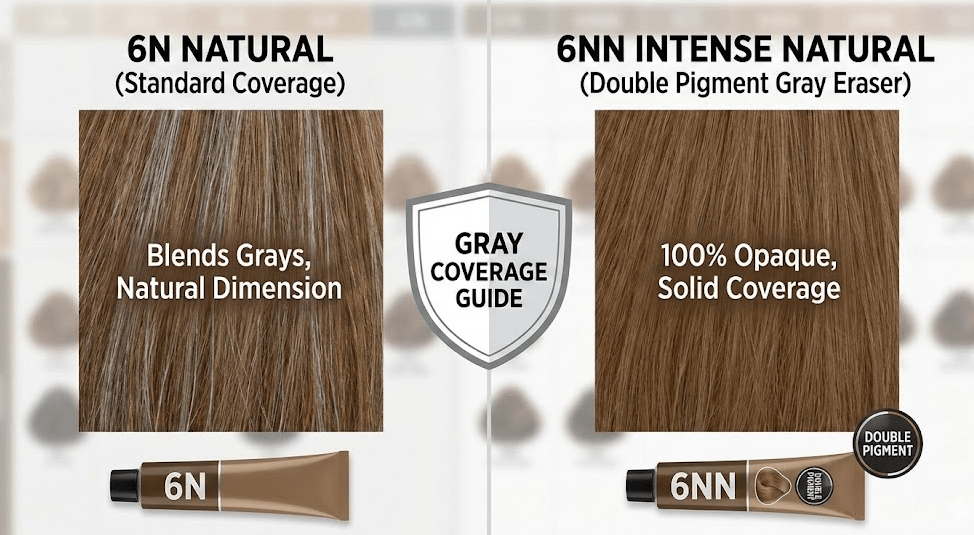
- 6N gives balanced, natural dark blonde with good coverage for non-resistant grey.
- 6NN has higher pigment for maximum, opaque coverage of stubborn, resistant grey.
- 6NN looks richer and more saturated; 6N can look slightly sheerer.
- Developer, porosity, starting colour and previous colour affect the result.
6N and 6NN codes can confuse anyone shopping for hair dye. This guide explains the differences in pigment, grey coverage and finish so you can choose the right shade.
This article keeps the focus on level, tone, pigment and coverage. It also covers developer, porosity and previous colour, because those details can change a result as much as the shade name itself does.
Quick Answer: 6N or 6NN?
6N is ideal for natural-looking blonde with good grey coverage. 6NN is specially formulated for stubborn, resistant grey hair, with enhanced pigment for 100% opaque coverage.
If your grey is fine and takes colour easily, 6N may be enough. If it looks translucent or sparkly after colouring, 6NN is designed for that problem.
How the Hair Colour Numbering System Works
Professional and retail dyes typically use a two-part system: a number for level and letters for tone. Understanding both makes the labels easier to read.
The First Number: Level 6 Means Dark Blonde
The first number shows depth or lightness, from 1 (black) to 10 (lightest blonde). Level 6 is dark blonde, balancing the richness of brown with the lightness of blonde.
The scale runs 1 black, 2 darkest brown, 3 dark brown, 4 medium brown, 5 light brown, 6 dark blonde, 7 medium blonde, 8 light blonde, 9 very light blonde and 10 lightest blonde. At level 6, hair has underlying warm pigments, specifically orange or red-orange tones, which can become visible during colouring.
The Letters: Tone and Undertone
The letters denote tone or undertone, and whether the shade appears warm, cool or neutral. Common letters include N = Natural/Neutral, A = Ash, G = Gold, C = Copper, R = Red, V = Violet and M = Mahogany.
What 6N Means: The Natural Series
An N after the level, as in 6N, signifies Natural or Neutral. It is a balanced dark blonde suitable for consistent, natural-looking results.
Characteristics of N Shades
- Balanced tones: Neither overtly warm, like gold or copper, nor overtly cool, like ash; they aim to mimic common natural hair colours.
- Neutral blend: A balanced blend of primary colours (red, yellow and blue) for a harmonious result.
- Grey coverage: Good coverage for most non-resistant grey, blending greys into the natural colour, especially where greys are not stubborn.
A 6N is a true, balanced dark blonde. It suits someone who wants a shade that could look naturally theirs, without strong red or golden undertones.
What 6NN Means: Double or Intense Natural
NN stands for Double Natural, Intense Natural or Extra Natural. That small addition significantly affects performance, particularly with challenging grey hair needing maximum coverage and intensity.
How NN Differs from N
- Increased dye load: NN contains a higher concentration of natural pigments than N; think of it as a double dose of colour.
- Enhanced grey coverage: Formulated for stubborn, resistant grey that seems to repel colour or ends up translucent; 6NN is designed to deliver 100% opaque coverage.
- Intensity: NN can appear slightly deeper, richer and more opaque than N at the same level; it is more saturated, not necessarily darker in level.
- Cooler bias (brand dependent): Some brands give NN a slightly cooler bias to counteract underlying warm pigments and prevent colour pulling too warm.
6NN therefore gives a richer, more solid and opaque dark blonde. It is the go-to choice for a high percentage of resistant greys, or a more saturated result.
Side-by-Side Comparison: 6N vs. 6NN
This table summarises the main distinctions between the two shades.
| Feature | 6N (Natural Dark Blonde) | 6NN (Intense Natural Dark Blonde) |
|---|---|---|
| Meaning | Natural/Neutral Dark Blonde | Double/Intense Natural Dark Blonde |
| Dye Load | Standard pigment concentration | Higher pigment concentration |
| Grey Coverage | Good for non-resistant greys | Excellent for resistant/stubborn greys, 100% coverage focus |
| Colour Intensity | Natural, balanced depth; can appear slightly sheerer | More opaque, richer, and saturated |
| Result | True-to-tone dark blonde | Deeper, more solid dark blonde |
| Best For | Achieving a natural dark blonde, slight tone adjustment | Achieving full grey coverage, adding depth and richness |
When to Choose Which Shade
Use the amount and type of grey you have, and the finish you want, as your main guides.
Choose 6N If
- You have minimal to no grey hair, or your greys are fine and easily covered.
- You want a natural-looking dark blonde that is not overly deep or opaque.
- You want a balanced base before adding other tones, like highlights or lowlights, later.
- Your hair generally accepts colour well and does not struggle with absorption.
Choose 6NN If
- You have resistant grey that does not hold colour well, leaving a translucent or sparkly effect.
- You want maximum, opaque grey coverage and want your greys to disappear completely.
- You want a richer, more intense and saturated dark blonde result.
- You want to counteract strong underlying red/orange tones that might pull through with a regular N shade.
Other Factors That Affect the Result
The shade in the tube is not the only factor. The same colour can look different from one head of hair to another.
- Developer volume: Developer determines how much natural pigment is lifted and how much colour is deposited; for standard deposit and grey coverage, 20 volume is typically recommended.
- Hair porosity: Porosity is the hair’s ability to absorb and retain moisture and colour; highly porous hair can absorb faster and appear darker, while low porosity hair can resist absorption.
- Natural hair colour: Your starting colour significantly impacts the result; dyeing dark hair lighter requires different processes than dyeing lighter hair darker.
- Previous colour: Existing dyes, especially permanent ones, can affect how new colour takes; colour does not lighten colour, so layering requires care.
Professional Advice and Safety Checks
- Always perform a patch test: Crucial to check for allergic reactions before applying colour to your entire head.
- Strand test first: Apply mixed colour to a small, inconspicuous strand to show exactly how the colour will look.
- Consult a professional: For complex changes, significant grey percentages, or if you are unsure, a stylist can give personalised advice and minimise damage and disappointment.
- Brand variations: While the numbering system is universal, the exact nuances of N and NN can vary slightly between brands.
Frequently Asked Questions
What percentage of grey should I use 6NN for?
Use the percentage of 6NN that matches your grey percentage; for example, 75% grey means mixing 75% 6NN with 25% of another shade, and 100% grey means using 100% 6NN.
Can I mix 6N and 6NN together?
Yes. If 6N seems too light and 6NN too dark, blending them creates a custom shade, a common technique among professional colourists.
How long does 6N or 6NN colour last?
With colour-safe shampoo and conditioner, it typically lasts 4-6 weeks before significant fading. Root touch-ups may be needed every 4-8 weeks, depending on growth rate.
Which is better for first-time colourers?
6N is generally better, because it is more forgiving and gives good results without the heavy pigment load of 6NN. 6NN requires more careful application due to its intensity.
Does 6NN leave a green or brassy tint?
6NN can appear slightly ashier due to its higher pigment concentration, but it should not leave a green tint if used correctly. Pre-pigmenting with a base colour prevents unwanted cool tones.
What developer should I use?
Use 20 volume for both as standard. Only use 10 volume for a gloss or toner on previously coloured hair, and never use 40 volume, as it may cause damage and uneven colour.
Are 6N and 6NN permanent?
Both are permanent when mixed with developer; they will not wash out but will fade gradually. Semi-permanent alternatives exist but offer less grey coverage.
Conclusion: Pigment Is the Main Difference
The difference boils down primarily to pigment concentration and, consequently, grey coverage ability. 6N offers a beautiful, natural dark blonde for general use, while 6NN steps up for stubborn greys and a richer, more intense result.
In practice, start by judging how resistant your grey is, rather than by the level number alone, which is the same for both shades. If grey is fine and colour takes easily, 6N gives the softer, sheerer natural finish described above; if grey is resistant or still translucent after colouring, 6NN gives the higher pigment load described for that case.
By understanding these nuances, you are better equipped to make confident choices. Always perform patch and strand tests before full application.
This article is general information only and is not medical advice. Please consult a healthcare professional for personal advice.