As an Amazon Associate, CureTips24 earns from qualifying purchases. We did not test these humidifiers in person; this guide is based on maker specifications, independent lab tests and health guidance. It is general information, not medical advice.
When the heating comes on in winter, indoor air gets dry, and many people notice it first on their skin: tight cheeks, flaky patches, itchy shins and cracked lips. A humidifier adds moisture back into the air, and running one in your bedroom overnight is one of the simplest ways to make dry winter air more comfortable.
This guide compares the best humidifiers for dry skin, with a focus on quiet bedroom models that are easy to keep clean. It also covers the right humidity level, the safety steps that matter most, and what a humidifier can realistically do for your skin.
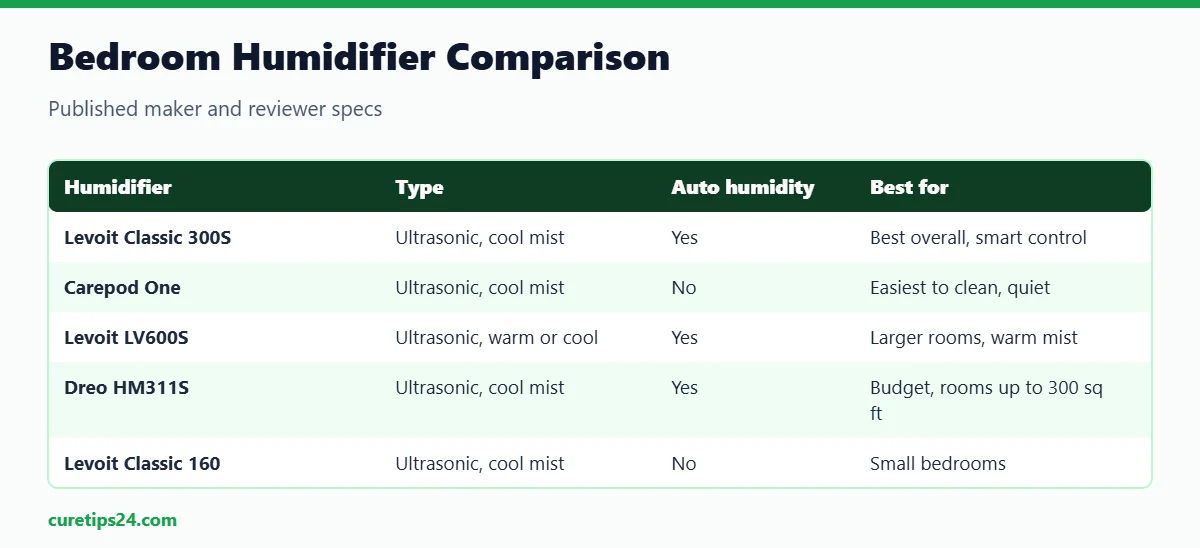
Table of Contents
Quick Picks
- Best overall: Levoit Classic 300S
- Easiest to clean: Carepod One
- Best for larger rooms and warm mist: Levoit LV600S
- Best budget smart pick: Dreo HM311S
- Best for small bedrooms: Levoit Classic 160
Can a Humidifier Help Dry Skin?
Low humidity is a well-known cause of dry skin. Mayo Clinic explains that low humidity can dry the skin and irritate the nose, throat and eyes, and that the ideal indoor humidity is between 30% and 50%. Many people find their skin feels more comfortable when they bring a very dry bedroom back into that range.
It is fair to say the research is mixed, though. AARP reports that a 2021 Cochrane review of workplace studies found humidification had little to no effect on skin dryness, while an older study found it helped. In practice, a humidifier works best as one part of a dry-skin routine that includes gentle cleansing and a good moisturizer, not as a treatment on its own. If your dry skin is severe, cracked, very itchy or not improving, see a doctor or dermatologist.
1. Levoit Classic 300S
Best overall. The Classic 300S is one of the best-selling humidifiers and RTINGS names it the best budget humidifier for bedrooms. It is an ultrasonic cool-mist model with a 6-liter top-fill tank, a built-in humidity sensor for auto mode, a quiet sleep mode, and app and voice control. In CNN Underscored’s testing, its 6-liter tank lasted about 39 hours on low. The humidity sensor matters for dry skin: you can set a target, such as 45%, and the humidifier adjusts its output to hold it instead of over-humidifying the room.
Pros: auto humidity control, big tank, top fill, smart features, quiet.
Cons: like all ultrasonic models, it needs distilled water and frequent cleaning to avoid white dust and buildup.
Check the Levoit Classic 300S on Amazon
2. Carepod One
Easiest to clean. RTINGS names the Carepod One the best bedroom humidifier it has tested, scoring it very highly for both noise and cleaning. Its simple design has few hidden parts, so it is easy to wash thoroughly, which is the single most important safety habit with any humidifier. The trade-off is that it has no built-in humidistat, so pair it with a cheap hygrometer to keep an eye on humidity.
Pros: very quiet, very easy to clean, simple design.
Cons: no auto humidity control; smaller output than larger models.
Check the Carepod One on Amazon
3. Levoit LV600S
Best for larger rooms and warm mist. RTINGS describes the LV600S as a hybrid warm and cool mist model with more capacity than the Classic 300S and the same smart features. Warm mist can feel more comfortable in a cold bedroom, and the extra output helps in large primary bedrooms or open spaces. It has a 6-liter tank and auto mode.
Pros: warm or cool mist, higher output, auto humidity, app control.
Cons: bigger and pricier; warm mist uses more power.
Check the Levoit LV600S on Amazon
4. Dreo HM311S
Best budget smart pick. CNN Underscored named the Dreo HM311S its best budget humidifier. It has a 4-liter tank, smart controls and is designed for rooms up to 300 square feet, and CNN found its performance nearly on par with larger 6-liter rivals. It is a good fit for an average-size bedroom.
Pros: affordable, smart features, top fill, good performance for its size.
Cons: smaller tank than the Levoit 300S.
Check the Dreo HM311S on Amazon
5. Levoit Classic 160
Best for small bedrooms. If you have a small bedroom, dorm room or home office, the Classic 160 is a compact, low-cost option. BestReviews lists it with a 2.5-liter tank, about 25 hours of runtime and coverage for about 280 square feet. It is simple to use and quiet enough for sleeping.
Pros: compact, affordable, quiet, top fill.
Cons: no humidity sensor; too small for large rooms.
Check the Levoit Classic 160 on Amazon
Types of Humidifiers
- Ultrasonic cool mist: uses a vibrating plate to create a fine mist. Quiet and energy-efficient, but can spread minerals from tap water as white dust. Use distilled water.
- Evaporative: a fan blows air through a wet wick filter. It does not spread white dust and naturally limits over-humidifying, but the filter needs replacing and the fan makes some noise.
- Warm mist (steam): boils water to create steam. The boiling kills many germs, but hot water and steam can burn, so keep them away from children and pets.
- Hybrid: combines ultrasonic with a warm mist option.
Mayo Clinic notes that evaporators and steam vaporizers may be less likely to release airborne allergens than cool-mist humidifiers. Whatever type you choose, regular cleaning matters most.
How to Use a Humidifier Safely
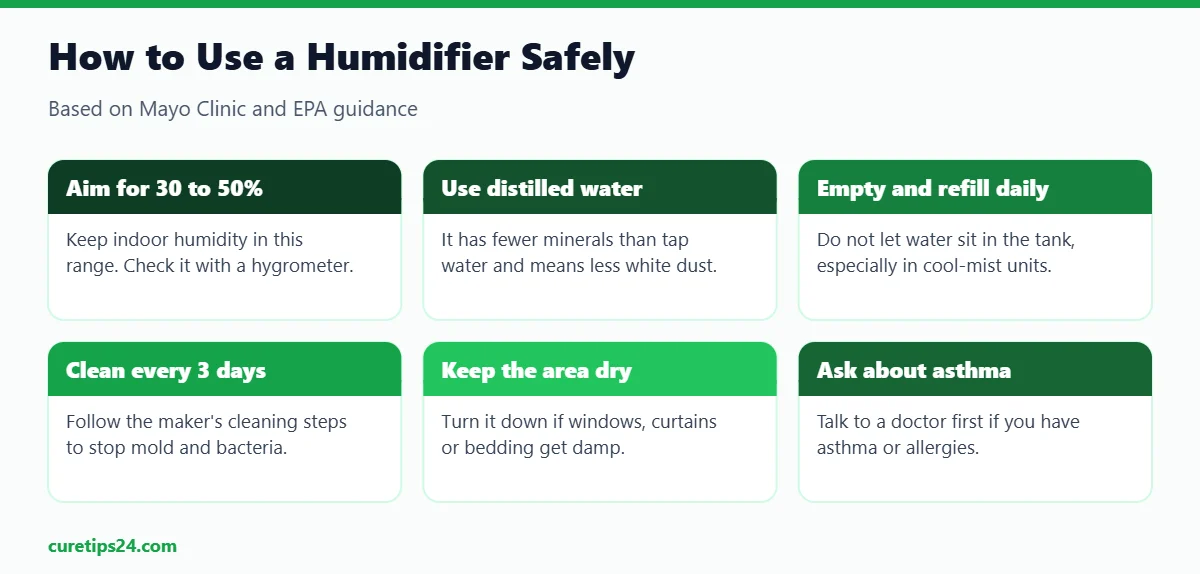
- Keep humidity between 30% and 50%. Too much moisture can encourage mold and dust mites. A built-in humidistat or a cheap hygrometer helps.
- Use distilled or demineralized water. Mayo Clinic notes it has fewer minerals than tap water, which means less white dust and less buildup.
- Empty and refill the tank daily. Dry the inside before refilling, especially with cool-mist and ultrasonic models.
- Clean it every three days, following the maker’s instructions. Do not add anything to the water unless the maker approves it.
- Keep the area dry. If windows, curtains or bedding get damp, turn it down.
- Talk to a doctor first if you or your child has asthma or allergies.
- Clean and dry it before storage at the end of the season.
Where to Put Your Humidifier
- Place it on a flat, water-resistant surface at least a couple of feet off the floor.
- Keep it a few feet from your bed so mist does not land directly on bedding.
- Do not point the mist at walls, furniture, electronics or books.
- Keep warm mist units out of reach of children and pets.
- Close the bedroom door at night so it can humidify the room efficiently.
A Simple Dry Skin Routine
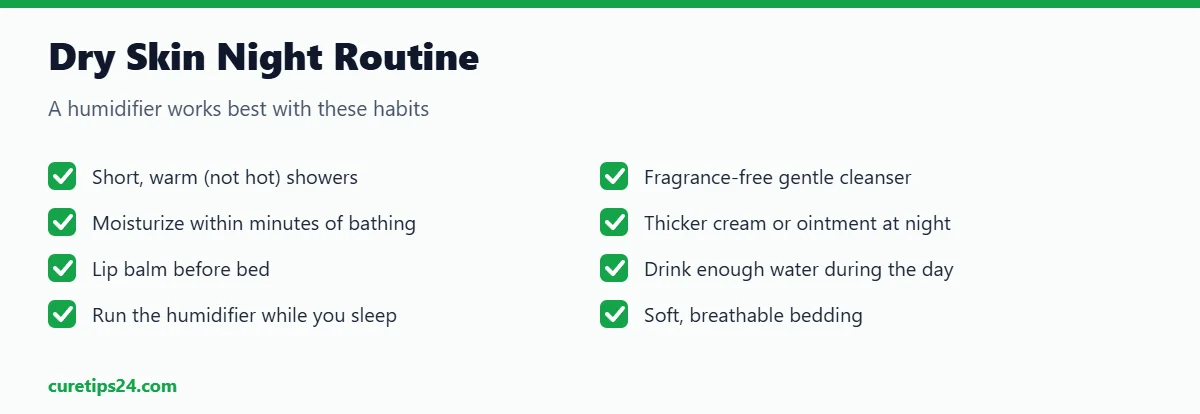
A humidifier works best alongside good skin care habits. Keep showers short and warm rather than hot, use a gentle fragrance-free cleanser, and apply moisturizer within a few minutes of bathing while your skin is still slightly damp. At night, a thicker cream or ointment can help seal in moisture. For more ideas, see our guides to winter skin care tips, how to maintain skin hydration and natural remedies for dry skin patches.
It also helps to know whether your skin is dry (lacking oil) or dehydrated (lacking water), because the best products differ. Our guide to dry vs dehydrated skin explains the difference.
Signs the Air in Your Home Is Too Dry
- Skin feels tight or itchy soon after washing, even when you moisturize.
- Lips crack and stay chapped through the winter.
- You wake up with a dry nose, throat or eyes.
- You get small static shocks from door handles and blankets.
- Wooden furniture or floors develop small gaps or cracks.
- A hygrometer reads below about 30% humidity.
A hygrometer is the easiest way to know for sure. They are inexpensive and help you avoid both over- and under-humidifying. See digital hygrometers.
Matching Tank Size to Your Room
A humidifier that is too small for the room will run constantly without reaching your target, while one that is too big can make a small room damp. Check the maker’s room coverage rating and compare it with your bedroom’s size. As a rough guide, compact 2 to 3 liter models suit small bedrooms and nurseries, 4 to 6 liter models suit average bedrooms, and larger units or hybrids suit big primary bedrooms or open spaces. A bigger tank also means fewer refills, which is helpful if you want to run it all night. Remember that coverage ratings are usually measured in ideal conditions, so drafty rooms or very cold weather may need more output.
How to Clean a Humidifier
- Unplug it and empty any water from the tank and base.
- Rinse and wipe the tank and base with clean water, using a soft brush for corners.
- Remove scale with white vinegar or the cleaning solution the maker recommends. Mayo Clinic also mentions a 3% hydrogen peroxide solution for removing deposits and film.
- Rinse thoroughly so no cleaning solution remains, then let all parts dry.
- Replace filters or cartridges on schedule if your model uses them.
Always follow your humidifier’s manual, because some parts cannot be soaked or put in a dishwasher.
An Evaporative Option: Honeywell HCM-350
If you do not want to deal with white dust or want a type that naturally limits how humid a room can get, an evaporative humidifier is worth considering. The Honeywell HCM-350 is a long-running popular evaporative model that uses a wick filter and UV technology. You will need to replace its filter regularly, and the fan is audible, but it is a good choice if you prefer evaporative humidification. Check the Honeywell HCM-350.
Other Ways to Add Moisture to Your Skin and Air
- Lower the thermostat a little at night; hot, dry air pulls more moisture from skin.
- Leave the bathroom door open after a shower to let steam into nearby rooms.
- Choose rich, fragrance-free creams in winter. See our guide to organic skin moisturizers for ideas.
- Wear gloves outside in cold, windy weather to protect your hands.
Frequently Asked Questions
What humidity is best for dry skin?
Mayo Clinic recommends keeping indoor humidity between 30% and 50%. Going above 50% can encourage mold and dust mites.
Should I run a humidifier all night?
Many people do, especially in winter. A model with auto mode helps prevent the room from getting too humid. Empty and refill the tank each day.
Cool mist or warm mist for skin?
Both add the same moisture to the air. Cool mist is safer around children and uses less energy; warm mist can feel cozier in a cold room.
Why is there white dust around my humidifier?
That is usually minerals from tap water released by an ultrasonic humidifier. Switching to distilled water or a demineralization cartridge reduces it.
Can I add essential oils?
Only if the maker says the model is designed for it, usually with a separate aroma pad. Mayo Clinic advises not adding anything to the water unless the maker approves it.
Is a humidifier safe for babies and children?
Many parents use cool-mist humidifiers in children’s rooms. Cool mist avoids the burn risk of hot water and steam. Keep the unit out of reach, clean it often, and ask your child’s doctor first if your child has asthma or allergies.
How long does it take to notice a difference?
Room humidity can rise within an hour or so, depending on room size and output. Changes in how your skin feels are usually gradual, and they depend just as much on your cleansing and moisturizing routine.
Do I need a humidifier in summer?
Usually not, because humidity is naturally higher. In air-conditioned rooms or dry climates, a hygrometer will tell you whether you need one.
Final Verdict
The Levoit Classic 300S is our top pick for dry skin because its humidity sensor keeps your bedroom in a comfortable range automatically. Choose the Carepod One if easy cleaning matters most, the Levoit LV600S for larger rooms or warm mist, the Dreo HM311S for a budget smart option, and the Levoit Classic 160 for a small bedroom. Whatever you choose, keep it clean, use distilled water and pair it with a simple moisturizing routine.
Browse bedroom humidifiers on Amazon