Revlon is one of the best-known names in budget hair tools. Walk into almost any pharmacy, supermarket or big-box store and you will find at least one Revlon blow dryer on the shelf, usually at a price well below salon brands. The range has grown over the years, though, and the boxes all seem to promise the same things: 1875 watts, ionic technology, ceramic coating and less frizz.
This review looks past the packaging. It explains the main types of Revlon handheld blow dryers, what the common features actually do, who each style suits, and how to use any Revlon dryer in a way that limits heat damage. If you are interested in Revlon’s round-brush hot air tools instead, see our separate Revlon One-Step Hair Dryer and Volumizer review.
Table of Contents
A Quick Background on Revlon Hair Tools
Revlon is famous as a makeup brand, but its hair dryers and styling tools are made under licence by Helen of Troy, a consumer products company that also makes tools for other brands. That arrangement is one reason Revlon dryers are so widely available and so competitively priced.
Most of the range sits in the budget to mid-price bracket. Models change regularly, colours come and go, and the same dryer may be sold under slightly different names by different retailers. It is therefore more useful to understand the feature families than to chase one exact model number.
The Main Types of Revlon Blow Dryer
Revlon’s handheld dryers fall into a few broad groups. The details below reflect retailer listings at the time of writing, so always check the box or product page for the exact model you are buying.
| Dryer type | Key features | Best for |
|---|---|---|
| Infrared dryer | 1875 W, infrared heat, triple ceramic coating, tourmaline ionic technology, concentrator and finger diffuser | Thick or frizz-prone hair that takes a long time to dry |
| Turbo dryer | 1875 W, turbo boost button, ceramic coating, ionic technology | People who want fast, simple everyday drying |
| Smooth Brilliance AC motor dryer | 1875 W, AC motor, 3 heat and 2 speed settings, ceramic and tourmaline ionic technology | Frequent users who want a longer-lasting motor |
| Volume Booster dryer | 1875 W, 3 heat and 2 speed settings, ionic technology, volumising finger diffuser | Fine hair, curls and waves that need lift |
| Dry Max dryer | 1875 W, triple ceramic titanium coating, tourmaline ionic technology, 120 V/240 V dual voltage | Travellers and people who want a full-size dryer with a dual-voltage plug |
| Compact or travel dryer | Smaller body, lighter weight, ionic technology, cool shot on some models | Gym bags, short hair and occasional use |
Most Revlon dryers sold in the US are rated for 120 volts only. A 120 V dryer should not be plugged into a 220–240 V socket with a simple plug adapter, because it can overheat or burn out. If you live outside North America, buy a model made for your local voltage or one that is clearly marked as dual voltage.
What the Common Features Actually Do
Revlon boxes use a lot of the same terms. Here is what they mean in plain language.
1875 watts
Wattage is a rough guide to power. 1875 W is the standard maximum for full-size household dryers in North America, so almost every full-size Revlon model is rated at this level. More watts usually means faster drying, but technique and airflow matter just as much.
Ionic technology
Ionic dryers release negatively charged ions. The idea is that these help break up water droplets and reduce static, which can leave hair looking smoother. Many users notice less flyaway frizz, although results vary with hair type, humidity and products.
Ceramic and tourmaline coatings
Ceramic coatings on the heating element are designed to spread heat more evenly and reduce hot spots. Tourmaline is a mineral added to some coatings and is marketed as boosting the ionic effect. These are useful features, but they do not make high heat harmless.
Infrared heat
Infrared models are marketed as drying hair from the inside out and helping it hold on to moisture. The marketing claims are hard to verify independently, so treat them as a possible bonus rather than a guarantee.
AC versus DC motors
AC motors are common in salon dryers and are generally heavier but durable. DC motors are lighter and cheaper. Revlon’s Smooth Brilliance line advertises an AC motor that lasts longer than a typical dryer motor, which may appeal to people who blow-dry every day.
Pros and Cons of Revlon Blow Dryers
Pros:
- Affordable compared with premium brands.
- Easy to find in shops and online, with replacements readily available.
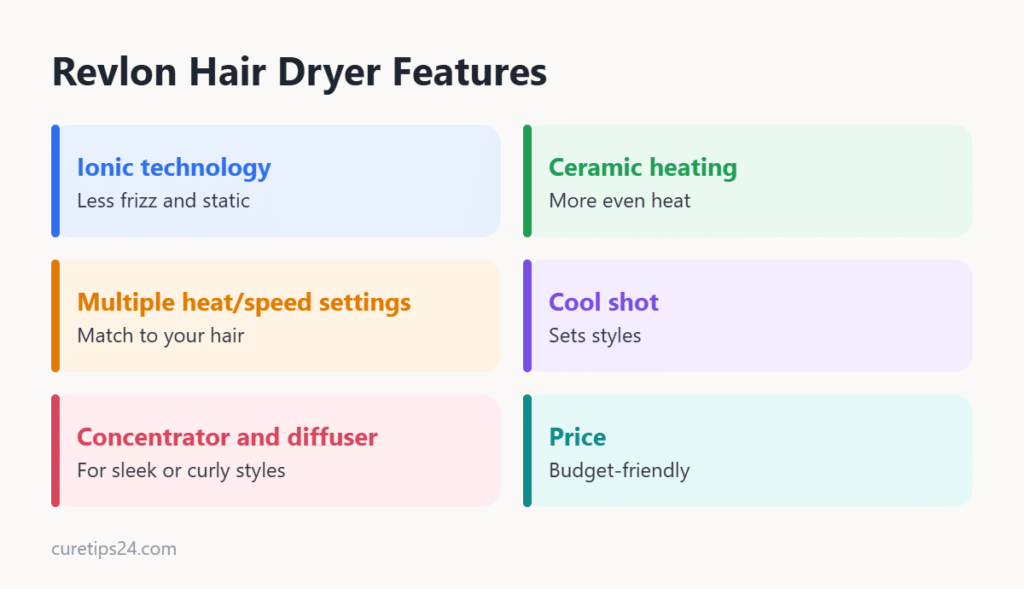
- Most full-size models include several heat and speed settings plus a cool shot.
- Many come with a concentrator and diffuser, so one dryer can handle straight and curly styles.
- Removable end caps on many models make lint cleaning easy.
Cons:
- Most full-size models are heavier and louder than high-end dryers.
- Many US models are 120 V only, which limits international use.
- Build quality is mid-range, and lifespan varies between models.
- Marketing claims such as “45% faster” are made by the brand against its own older models, not against every dryer on the market.
Who Should Choose a Revlon Dryer?
A Revlon dryer is a sensible choice for students, first-time buyers, people on a budget and anyone who wants a dependable backup dryer. It also suits people who blow-dry a few times a week and do not need salon-level speed or quietness.
If you have very thick, long or tightly curled hair and blow-dry daily, a higher-end dryer with stronger airflow may save time over the long run. Our guide to the best hair dryer for curly hair compares options for curls, and our explainer on the difference between a hair dryer and a blow dryer clears up the terminology.
How to Blow-Dry With Less Damage
The dryer matters, but the way you use it matters more. A widely cited 2011 study in the Annals of Dermatology tested hair dried naturally and with a dryer at different temperatures and distances. It found that blow-drying causes more surface damage than air-drying, but drying at a distance of about 15 cm (6 inches) with continuous motion caused less overall damage than leaving hair to dry naturally. You can read the full study on PubMed Central.
The American Academy of Dermatology suggests using the lowest heat setting, letting hair air-dry when possible and cutting down on how often you use heat. Its guide to hair care habits that can damage your hair is worth a read.
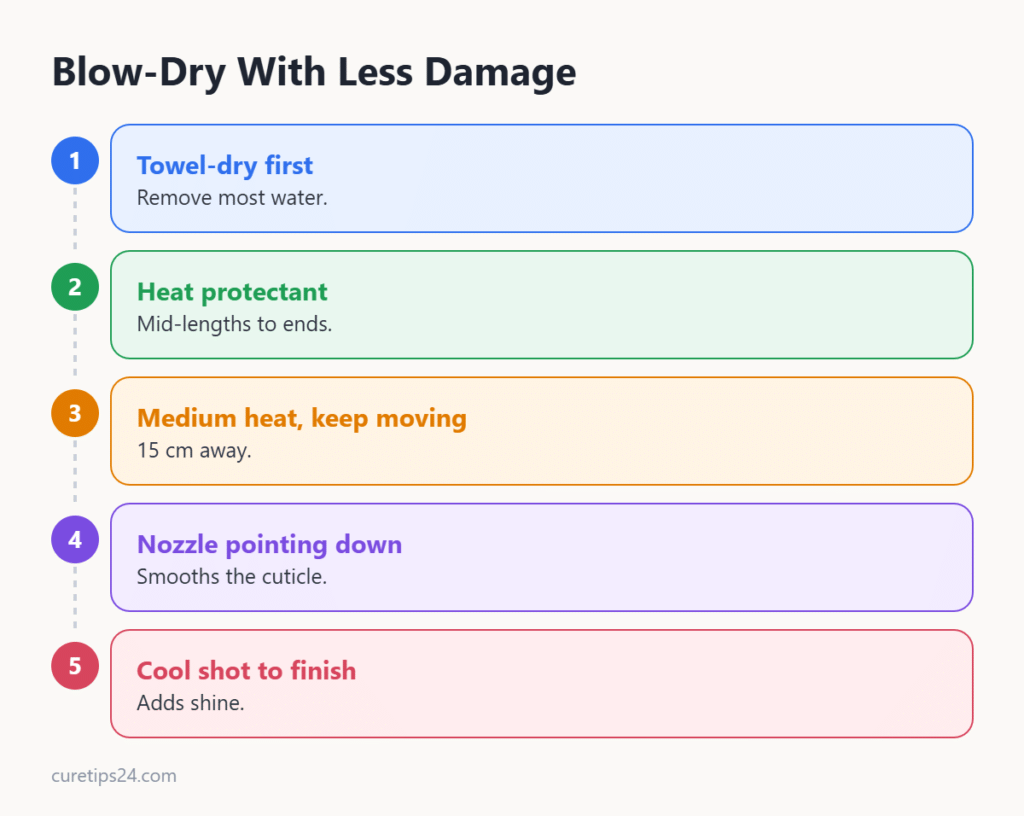
- Remove excess water first. Blot hair gently with a microfibre towel or cotton T-shirt instead of rubbing.
- Apply a heat protectant. Spray it evenly through damp hair before you switch on the dryer.
- Start on low or medium heat. Only increase the heat if your hair truly needs it.
- Keep the dryer moving. Hold it about 15 cm away and avoid pointing it at one spot.
- Work in sections. Clip hair into sections and dry each one fully before moving on.
- Use the right attachment. A concentrator for smoothing, a diffuser for curls and waves.
- Finish with the cool shot. A blast of cool air helps set the style.
On days when you want to skip heat altogether, our guide on how to dry hair without a blow dryer has simple techniques that work for most hair types.
Safety and Maintenance Tips
- Never use a dryer near a filled sink or bath, and unplug it straight after use.
- Clean the rear filter or end cap regularly, as trapped lint can make the motor overheat.
- Do not wrap the cord tightly around the handle, as this can damage the wiring over time.
- Stop using the dryer if it sparks, smells of burning or cuts out repeatedly.
- Check the voltage before travelling, and do not rely on a plug adapter alone.
For more general advice on keeping hair strong between styling sessions, the AAD’s tips for healthy hair cover washing, conditioning and styling.
Frequently Asked Questions
Are Revlon hair dryers good?
For the price, most Revlon dryers are solid everyday tools. They are not as light, quiet or fast as premium dryers, but they offer useful features such as multiple heat settings, a cool shot and attachments at a low cost.
Which Revlon dryer is best for frizzy hair?
Models with ionic technology and a ceramic or tourmaline coating, such as the infrared or Smooth Brilliance lines, are aimed at frizz control. A heat protectant and a smoothing concentrator will make a bigger difference than the dryer alone.
Can I use a Revlon dryer abroad?
Only if it is rated for the local voltage. Many US models are 120 V only. Dual-voltage models such as the Dry Max are designed for travel, but always check the label before plugging in.
Is blow-drying worse than air-drying?
Not necessarily. Research suggests a dryer used at a low setting, held about 15 cm away and kept moving can cause less damage than leaving hair wet for a long time.
Final Thoughts
The Revlon blow dryer range offers practical, affordable tools for everyday drying. Pick the type that matches your hair, such as an infrared or AC model for frizz, a volume booster for fine hair or a dual-voltage model for travel. Then use it well: low heat, a heat protectant, steady motion and a cool shot to finish. With good technique, even a budget dryer can give smooth, healthy-looking results.
This article is for general information only and is not medical advice. Talk to a doctor, dermatologist or other qualified health professional about your own skin, hair or health concerns before starting a new product, diet or treatment.