Table of Contents
Quick Summary / At A Glance
- Split-end menders, also called bond builders and end sealers, coat and temporarily stick frayed ends together; they do not truly repair split hair.
- A split end is damaged hair fibre that has frayed apart, and no product can fuse it back into undamaged hair.
- Only trimming removes split ends completely; menders buy time between trims and make ends look and feel smoother.
- Regular small trims actually help length retention, because they stop splits travelling up the hair shaft and breaking off higher up.
- Gentle handling, less heat and protecting ends from friction prevent new splits better than any mending product alone.
What Is a Split End, Exactly?
A split end happens when the protective outer layer of a hair strand wears away and the fibre frays, usually into two or more strands at the tip. Hair is not alive, so once that fibre has split, the body cannot heal it the way skin heals a cut.
Splits are most common in longer hair, because the ends are the oldest part of each strand and have survived years of washing, brushing, heat styling and sun. Fine, dry or chemically treated hair tends to split more easily, since its outer layer is already weaker.
You can spot splits by looking at the very ends in good light: instead of a clean, blunt tip, the strand forks, feathers or looks white and wispy at the end. Sometimes the split runs a centimetre or more up the shaft, especially if it has been left for months.
How Split-End Menders Claim to Work
Split-end menders come in several forms: leave-in creams, serums, oils and so-called bond-building treatments. Their marketing often uses words like “repair”, “mend” and “seal”, which sound permanent, but the mechanism underneath is much simpler.
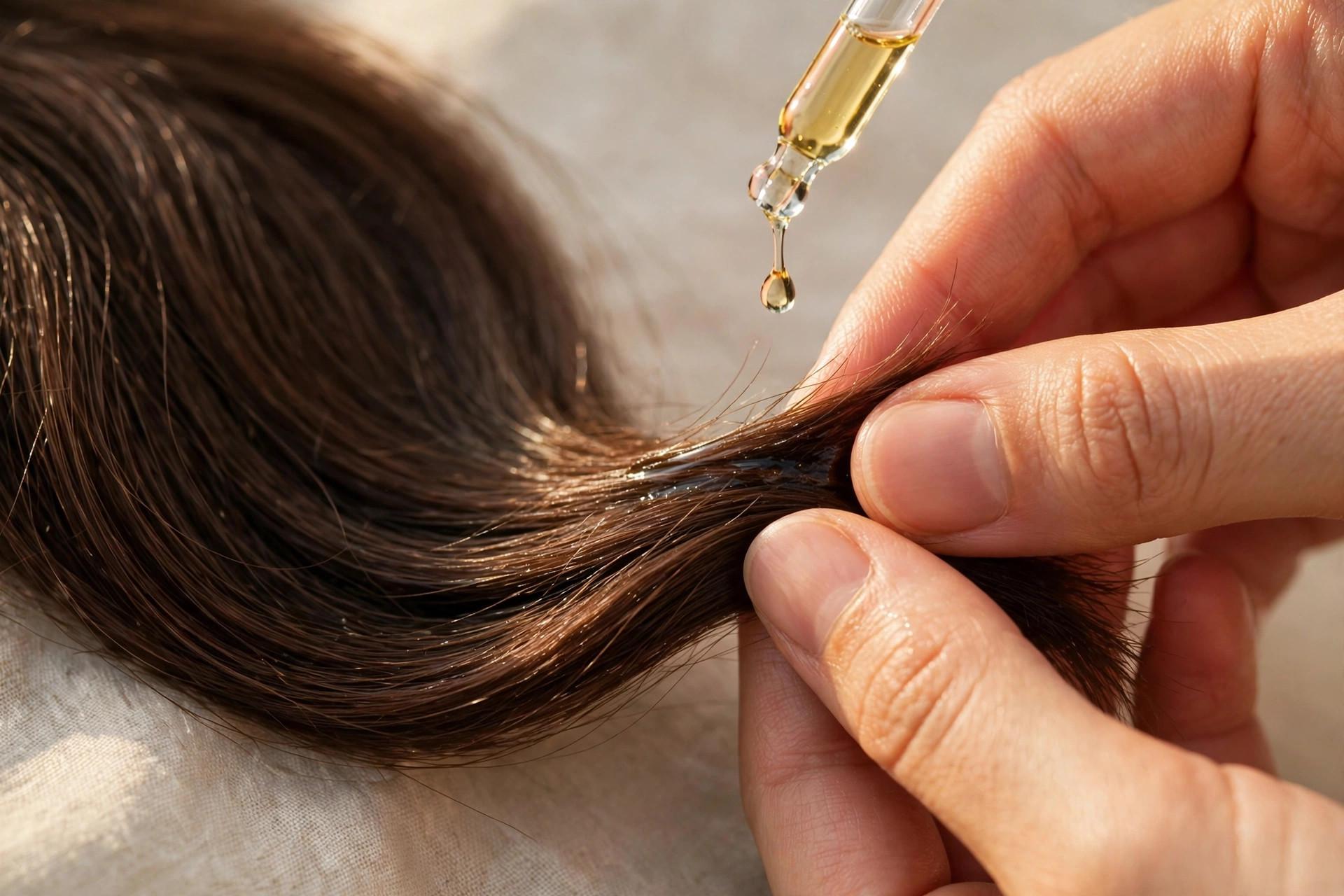
Most menders coat the hair shaft with conditioning agents and light polymers that smooth the cuticle and stick the frayed fibres together while the product is in place. The ends look sealed, feel smoother and catch less on each other, which reduces further tangling.
Bond-building products go a step further in their claims, saying they rebuild broken bonds inside the hair. These products can improve how damaged hair feels and behaves, particularly after chemical treatments, but they do not turn a split fibre back into a single, undamaged strand.
The honest summary is that menders manage the appearance and behaviour of splits. They are best understood as a cosmetic holding action: useful, sometimes impressively so, but temporary by nature.
Why a Mender Cannot Truly Repair a Split
The key misunderstanding is the word “repair”. In everyday language it suggests restoring something to its original state, but a split hair fibre cannot be restored that way. Once the fibre has separated, no cream can regrow the missing structure.
Think of it like a frayed rope. Glue can hold the frayed threads together and make the rope look tidy, and it may even stop the fraying spreading for a while. It cannot make the rope a single, unbroken rope again, and the glued section remains the weakest point.
This is why the effect of a mender fades with washing. Each wash removes some of the coating, the fibres separate again, and the split reappears. Reapplying the product repeats the smoothing effect, but the underlying split is still there underneath.
Only Trimming Truly Removes Split Ends
The only way to remove a split end completely is to cut it off. A trim takes away the damaged portion, leaving a clean, blunt end that is far less likely to fray again straight away. That clean end is also less likely to tangle and snap.
Many people avoid trims because they are trying to grow their hair longer, which is understandable. Yet skipping trims often works against that goal: an untrimmed split can travel up the shaft, so that when the hair finally breaks, it breaks higher up and more length is lost.
Small, regular trims — often called dusting when only a few millimetres are taken — remove splits while preserving almost all the length. A stylist can also use a technique called “search and destroy”, snipping individual splits, though this is slow and does not replace an even trim.
Split Ends and Length Retention: The Real Connection
Length retention is different from hair growth. Hair grows from the scalp at its own pace regardless of what happens at the ends, but how much of that growth you keep depends on how much breaks off at the ends.
This is where split-end care genuinely helps length. By smoothing ends, reducing tangling and preventing splits from travelling, menders and trims together reduce breakage. Less breakage means more of each month’s growth stays on your head.
Claims that a mender “grows hair” or “repairs hair from within” should be read carefully. The growth happens at the scalp, and the mender’s job is simply to stop the ends undoing that progress.
How to Use a Split-End Mender Well
If you use a mender, apply it mainly to the ends, not the roots. A pea-sized amount for medium-length hair is usually enough; too much leaves ends greasy and weighed down without adding benefit.
Apply to damp or dry ends after washing, and reapply lightly between washes if ends feel rough. Use it as part of a routine, not as a reason to postpone trims indefinitely: think of it as the product that keeps ends presentable between appointments.
A good scalp care routine complements end care, because a healthy scalp supports the new hair that will eventually become the ends. The two ends of the strand need different care, and both deserve attention.
Preventing New Splits Matters More Than Mending Old Ones
Prevention is where the biggest gains come from. Heat is the main culprit: high temperatures on already-dry ends weaken the fibre, so turning the heat down, using a heat protectant and air-drying when possible all help.
Brushing matters too. Detangle gently from the ends upward with a wide-tooth comb or a brush designed for wet hair, and avoid yanking through knots. Rough brushing is one of the fastest ways to create new splits.
Chemical treatments, including colouring, bleaching and repeated straightening, raise the risk of splits. Spacing treatments out, keeping hair conditioned and discussing gentler options with a stylist can reduce the damage without giving up styling altogether.
Split-End Care Compared
The table below compares the main approaches to split ends, based on what this article has discussed.
| Approach | What it does | What it cannot do | Best for |
|---|---|---|---|
| Split-end mender | Temporarily glues and smooths splits | Permanently repair split fibre | Looking tidy between trims |
| Regular trim | Removes splits completely | Grow hair faster | Stopping splits travelling upward |
| Conditioner | Reduces friction and dryness | Seal an existing split | Everyday prevention |
| Less heat and gentle brushing | Prevents new splits forming | Fix splits already present | Long-term length retention |
| Bond-building treatment | Improves feel of damaged hair | Restore a split to undamaged hair | Chemically treated hair |
The winning combination is not one product but a system: prevention to limit new splits, a mender to manage the ones you have, and regular trims to remove them for good.
Choosing a Mender Without the Hype
When shopping, ignore promises of permanent repair and look instead for a lightweight formula that suits your hair type. Fine hair needs a lighter serum, while thick or coarse hair can handle a richer cream without looking weighed down.
Be wary of products that claim to replace trims entirely, or that show a split “healing” in a dramatic before-and-after image. A product that keeps ends smooth for a few days is doing its real job; anything beyond that is marketing.
One related caution: products marketed for hair growth, including some hair growth shampoo claims, deserve the same sceptical reading. A shampoo washes the scalp; it cannot repair ends or change how fast hair grows.
When to See a Professional
Most split ends are a routine cosmetic issue, but a stylist can help when damage is extensive. If splits run far up the shaft, hair breaks in short pieces or ends feel straw-like despite careful care, a good cut and a simpler routine may be needed.
See a doctor if hair loss is sudden, patchy or accompanied by scalp pain, redness or scaling. Split ends do not cause that kind of hair loss, and a medical cause should not be masked by styling products.
The Bottom Line
Split-end menders work, but only within their real limits: they glue frayed ends together temporarily, making hair look smoother and break less between trims. They do not repair a split, and they cannot replace a trim.
Use a mender to keep ends presentable, trim regularly to actually remove splits, and protect ends from heat and rough handling to prevent new ones. That combination, not any single bottle, is what keeps length.
This article is general information only and is not medical advice. Please consult a healthcare professional for personal advice.