A makeup kit is one of the most requested gifts for young girls, and it is easy to see why. Children love copying the adults around them, and a palette of bright colours feels like a grown-up treasure. For parents, though, the question is not which kit looks the prettiest. It is which kit is safe for young skin, easy to wash off and suited to the child’s age.
This guide explains what to look for in a makeup kit for a girl child, which ingredients and formats deserve extra caution, how to judge a kit by age, and how to turn makeup play into a fun, hygienic routine. It is written for parents, grandparents and anyone buying a gift, and it focuses on safety rather than on any single brand.
Table of Contents
Why a Children’s Makeup Kit Needs Extra Care
Children’s skin is thinner and more reactive than adult skin, and young children are more likely to rub their eyes, lick their lips or put brushes in their mouths. That means a product that is fine on an adult face can still be a poor choice for a five-year-old.
There is also a regulatory gap worth knowing about. In the United States, the FDA does not approve cosmetics before they go on sale, and companies are responsible for the safety of what they sell. The FDA cosmetics section explains how the rules work, including the newer Modernization of Cosmetics Regulation Act (MoCRA). Rules differ in the UK, EU and other regions, so a label that is legal in one market may not meet the standards of another.
The Talc and Asbestos Issue Parents Should Know
The biggest safety story in children’s makeup over the last decade has involved talc. Talc is a mineral used in many powders, eyeshadows and blushes because it feels silky and helps colour spread. The problem is that talc and asbestos can form in the same rock, and poorly sourced talc can be contaminated.
In 2019, the FDA warned consumers not to use certain Claire’s eyeshadow, compact powder and contour palette batches after samples tested positive for tremolite asbestos. Claire’s disputed the test results but removed the items and its remaining talc-based cosmetics from stores. A Justice makeup product sold to children and teens had already been recalled in 2017 for the same reason. Later that year, a JoJo Siwa makeup set sold by Claire’s was also recalled after FDA testing.
The rules are still unsettled. MoCRA requires the FDA to set standard testing methods for asbestos in talc-containing cosmetics. The agency proposed a rule in December 2024 but withdrew it on 28 November 2025 after public comments, saying it would issue a new proposal later. Until that happens, there is no finalized federal testing standard in the US, and brands vary in how carefully they test. You can read the agency’s background on the FDA talc page.
The practical takeaway is simple: for a child’s kit, choose products clearly labelled talc-free where possible, especially loose or pressed powders that can be breathed in.
What to Look For in a Safe Makeup Kit
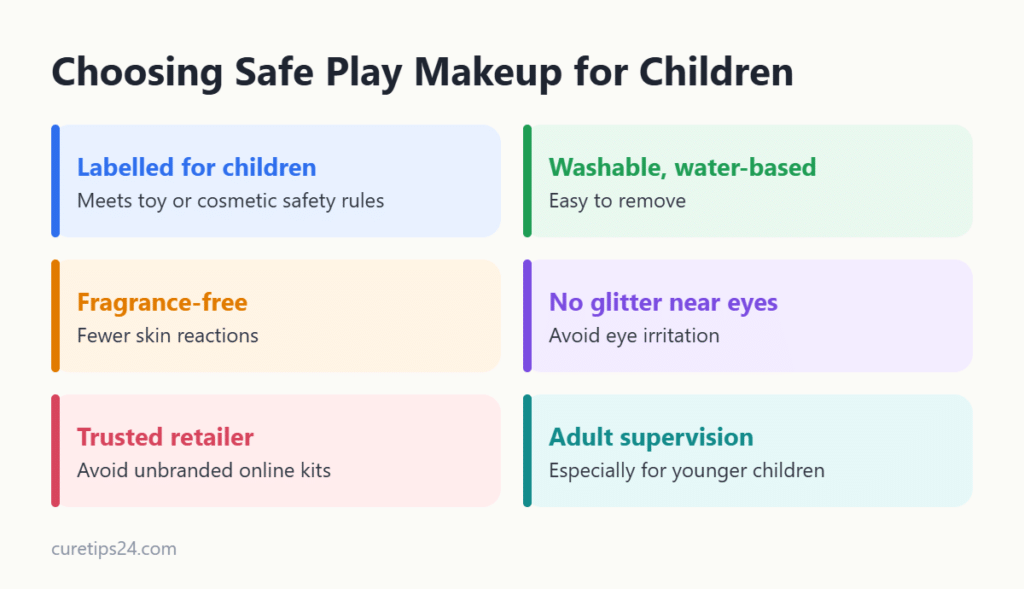
When you compare kits in a shop or online, check these points before you check the colours.
- Talc-free formula: look for the words on the packaging or the ingredient list, not just in an advert.
- Full ingredient list: a reputable kit lists every ingredient. Avoid kits with no list or with only a vague “non-toxic” claim.
- Water-washable: children’s makeup should come off with warm water and a gentle cleanser, without heavy scrubbing.
- Fragrance-free or low-fragrance: added fragrance is a common cause of skin irritation.
- Age guidance: check the recommended age on the box and the choking warning for small parts.
- Clear seller information: buy from known retailers so you can check for recalls and contact the maker if needed.
- Batch or lot number: this matters if a product is ever recalled.
Choosing a Kit by Age
Age is the most useful filter. A kit that suits a twelve-year-old is very different from one meant for a preschooler.
| Age | Good choices | Best to avoid |
|---|---|---|
| 3–5 years | Pretend makeup (empty or toy compacts), washable face paint made for children, play lip balm | Real powders, glitter, eye products, anything with small loose parts |
| 6–8 years | Water-based, talc-free play kits, tinted lip balm, washable nail polish | Adult palettes, strong fragrance, long-wear or waterproof formulas |
| 9–12 years | Simple tinted lip balm, a light cream blush, gentle mascara for special occasions | Heavy foundation, harsh removers, sharing eye products with friends |
| 13+ years | Light, non-comedogenic products as part of a skin care routine | Sleeping in makeup, expired products, products that sting or itch |
For the youngest children, pretend kits are often the best option. They give all the fun of opening a compact and “doing makeup” with nothing that touches the skin. For tweens, our guide to the best skin care products for 12 year olds covers the gentle basics that should come before makeup.
Ingredients and Products Worth Skipping
Ingredient labels can look intimidating, but a few items are worth spotting quickly.
- Talc in powders: choose talc-free versions for children, as explained above.
- Heavy fragrance: often listed as “parfum” or “fragrance” and a common trigger for irritation.
- Craft glitter: glitter not made for cosmetic use can scratch the eye. Use only cosmetic-grade glitter, and keep it away from the eyes for younger children.
- Adult eye products: eyeliner and mascara carry an infection risk if shared and are hard for small children to apply safely.
- Unknown imports: very cheap kits from unknown sellers may not follow any safety rules at all.
If a child’s skin turns red, itchy or swollen after makeup, wash it off and stop using the product. Irritant and allergic reactions are both forms of contact dermatitis, and MedlinePlus explains contact dermatitis and when to see a doctor.
Do a Patch Test First
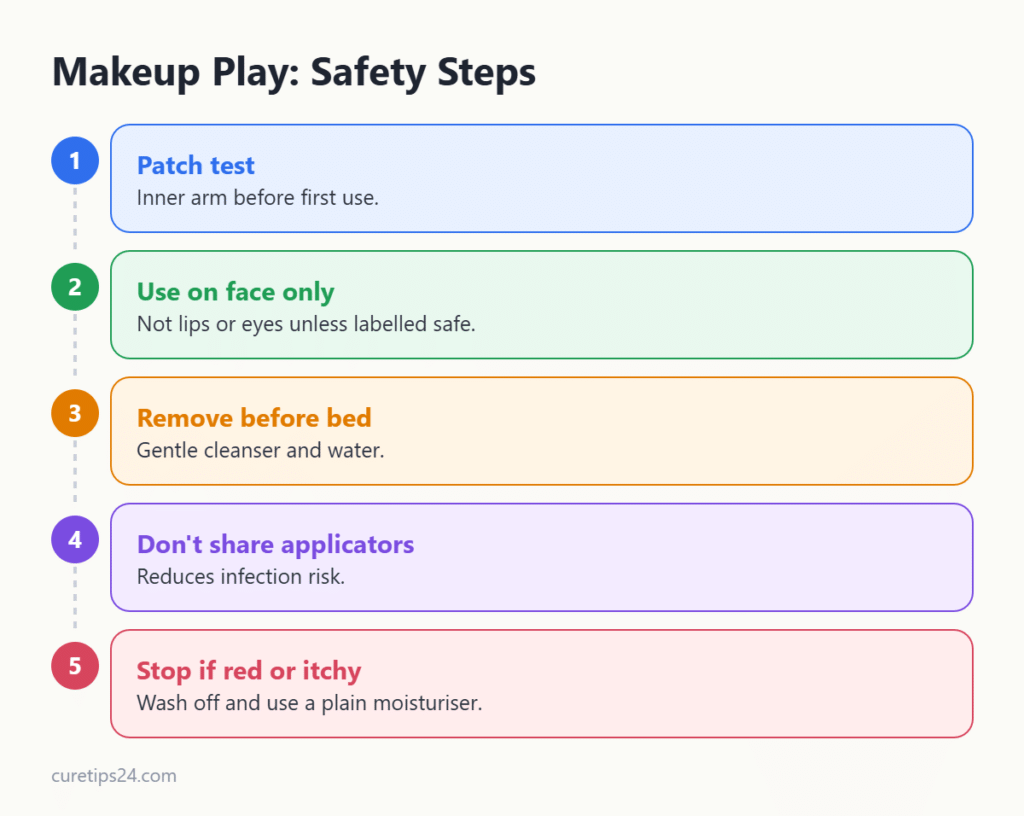
A patch test takes a little patience but can prevent a ruined birthday party. Dermatologists suggest applying a small amount of a new product to a small patch of skin, such as the inner arm, and watching for a reaction over a few days. The American Academy of Dermatology describes how to test products this way.
For a child, try one product at a time rather than the whole kit on day one. If a lip colour, blush or face paint causes no reaction, it can join the regular play routine.
Hygiene Rules for Makeup Play
Good habits matter as much as the products. These simple rules keep makeup play clean and safe.
- Wash hands first. Clean hands keep bacteria out of the palette.
- Do not share eye or lip products. Sharing can spread infections such as conjunctivitis and cold sores.
- Keep makeup away from the eyes for young children. Stick to cheeks, lips and nails.
- Clean brushes and sponges weekly. Use mild soap and warm water, then let them dry fully.
- Close lids after use. Open products dry out and collect dust.
- Remove makeup before bed. Never let a child sleep in makeup.
- Throw out old products. If something changes smell, colour or texture, replace it.
How to Remove Children’s Makeup Gently
Removal is where a lot of irritation happens. Children’s skin should not be scrubbed or wiped with harsh adult removers. Use warm water and a mild, fragrance-free cleanser on a soft cloth, pat the skin dry and follow with a simple moisturiser if the skin feels dry. Our guide to choosing a makeup remover for gentle removal explains which types are kindest to the skin.
If a product needs heavy rubbing or a special remover to come off, it is probably too long-wearing for a young child.
Making Makeup Play Fun and Healthy
Makeup play can be creative and confidence-building when the focus is on fun rather than on changing how a child looks. A few ideas:
- Use face paint for themed play, such as animals, superheroes or flowers.
- Set up a “salon” with a mirror, a towel and a washable kit for dress-up days.
- Talk about how makeup is for fun and self-expression, not something anyone needs to look good.
- Pair makeup play with a simple wash-and-moisturise routine, so good skin habits start early.
As children grow into their teens, the conversation naturally shifts toward skin care. The beauty tips for teenage girls guide and the teenage skin care routine guide are good next steps when that time comes.
Frequently Asked Questions
At what age can a girl start using a makeup kit?
There is no fixed medical age, but most parents start with pretend or washable play makeup around three to five years old and move to real, gentle products for special occasions as the child gets older. Follow the age guidance on the box.
Are children’s makeup kits regulated?
Yes, but loosely. In the US they are regulated as cosmetics, which are not approved before sale. The UK and EU have stricter ingredient rules. Buying from known retailers and checking for recalls adds a layer of protection.
Why does talc-free matter?
Talc can be contaminated with asbestos if it is not sourced and purified carefully, and several children’s makeup products have been recalled for this reason. Talc-free products remove that risk.
What should I do if my child has a reaction?
Wash the product off with water, stop using it and keep the packaging. If the rash spreads, the eyes are affected or the child has swelling or trouble breathing, get medical help straight away.
Final Thoughts
The best makeup kit for a girl child is not the biggest or the most colourful one. It is a kit that is talc-free, fully labelled, easy to wash off and right for her age, used with clean hands and simple hygiene rules. Start small, patch test new products and keep the focus on creativity and fun. That way, makeup play stays a happy memory rather than a skin problem.